
The Devil's Paintbrush: How the Machine Gun Broke Infantry Combat in WWI
05/13/2026

If you came up on M249s and M240s, on suppressive fire as a baseline assumption, on the idea that one fire team can pin down an entire enemy element while another flanks, you came up inside a tactical framework that did not exist in 1914.
It had to be invented under fire. And the people who invented it paid a price most modern shooters cannot fully imagine.
The machine gun is the weapon that broke infantry combat and forced every army on earth to rebuild it from the ground up. Every doctrine you take for granted, fire and maneuver, base of fire elements, the squad automatic weapon, the suppression-then-flank kill chain, came out of four years of trial and error in the mud between 1914 and 1918. The Americans arrived late, learned fast, and left their mark on the war in places like Belleau Wood and the Argonne forest. This is how that happened, and why the glass and rifles you run today still owe a debt to it.
Before the Machine Gun
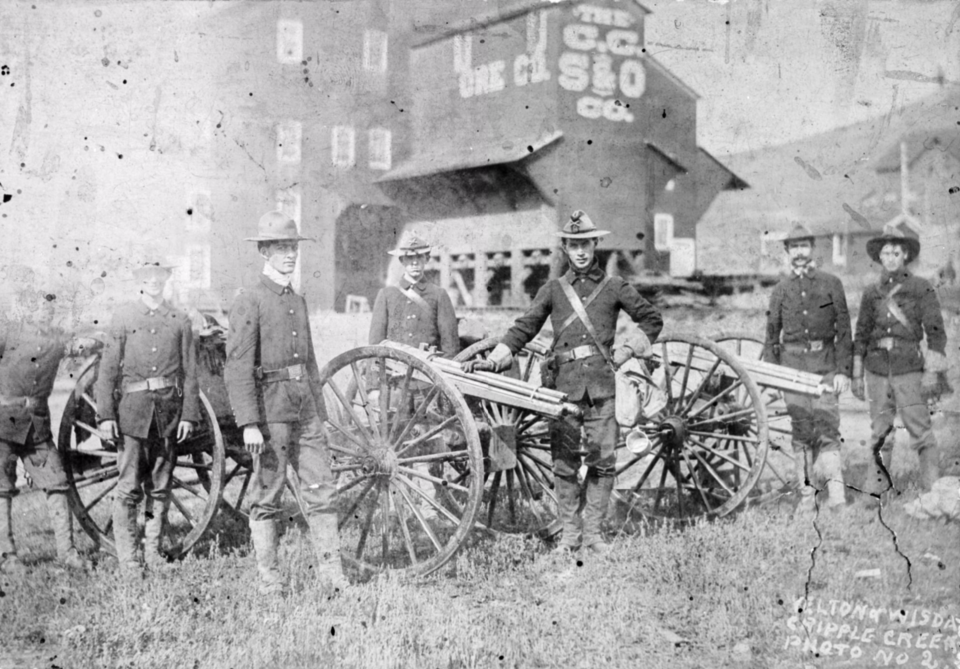
Before Maxim, infantry combat had not fundamentally changed in a century.
For most of the nineteenth century, infantry combat was a question of how many bodies you could put on a line and how fast they could load. Single-shot rifles. Volley fire. Bayonet charges to break the enemy formation once the volleys had softened it up. The American Civil War had hinted that this style of fighting was already obsolete. Pickett’s Charge ran into massed rifle fire and rifled artillery and dissolved. Cold Harbor produced casualty figures that should have changed everyone’s mind about frontal assault. But the lessons did not stick.
The Gatling gun, patented in 1862, was the first attempt at sustained automatic firepower. It was hand-cranked. The crew rotated a set of barrels mechanically while a hopper fed cartridges into the breech. It worked, sort of. It was heavy, it jammed when an inexperienced crank operator panicked, and the doctrine treated it as a piece of artillery rather than infantry support. It sat on a wheeled carriage. It belonged to the artillery branch. Generals thought of it the way they thought of a small cannon, not the way they would eventually think of a machine gun.
That paradigm held until a Maine-born engineer named Hiram Maxim figured out a better way to do it in 1884.
Hiram Maxim and the Devil’s Paintbrush
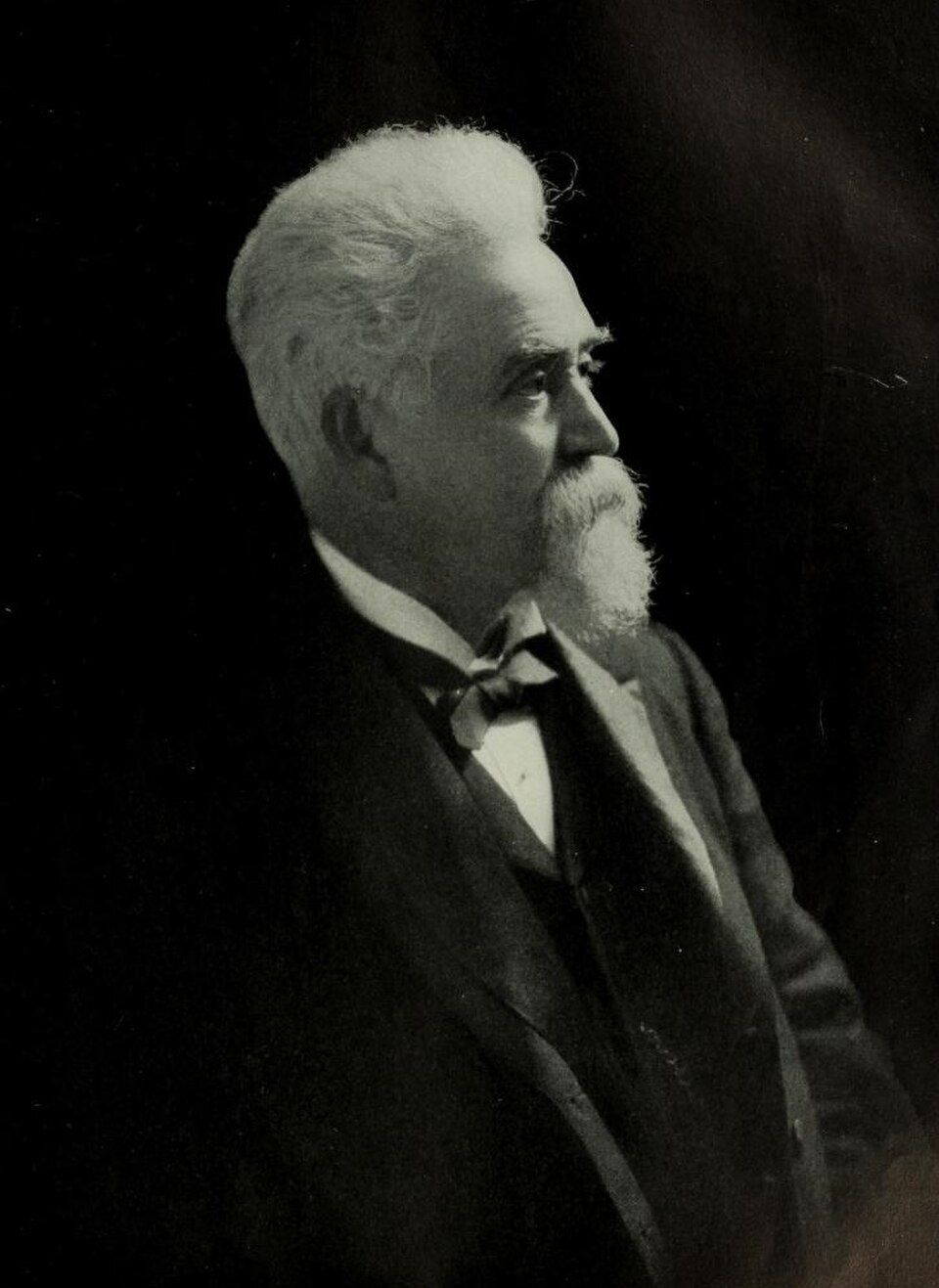
Maxim’s insight was elegant. A fired cartridge produces violent recoil energy. That energy is going somewhere. Why not use it to cycle the action?
His 1884 design did exactly that. When the gun fired, the recoil impulse pushed the barrel and breechblock rearward, unlocking the breech, ejecting the spent case, stripping a fresh round from a 250-round canvas belt, chambering it, and recocking the firing mechanism. As long as the trigger was depressed and the belt kept feeding, the gun kept firing. Roughly 600 rounds per minute, every minute, by one man. The equivalent of an entire Civil War regiment’s rifle fire concentrated in a single weapon.
Firing 600 rounds per minute generates enough friction to liquefy a steel barrel in short order, so Maxim wrapped his gun in a water-filled cooling jacket holding about a gallon of liquid. The water boiled off as steam during sustained fire. The crews learned to capture the steam, condense it back to water in a separate can, and reuse it. In the trench environment that was about to come, every gallon of water mattered.
Maxim reportedly built the weapon after a friend told him that if he wanted to make money, he should find a way for Europeans to kill each other faster. The advice was cynical and accurate. European militaries lined up to buy the design. The British, the Germans, and the Russians all adopted versions of it within a decade. Soldiers called it the Devil’s Paintbrush, after the way a single gun on its mount could sweep death laterally across a battlefield, painting an entire field with fire.
Two more innovations closed the loop. Smokeless powder, which came into widespread use in the late 1880s, replaced the thick white clouds of black powder smoke that would have given away any rapid-fire position within seconds. And small-caliber, high-velocity cartridges made the math of sustained fire workable across hundreds of yards of open ground.
By the early 1900s, every major European army had Maxim-derived machine guns in its inventory. Almost none of them understood what they actually had.
The Warning Europe Ignored
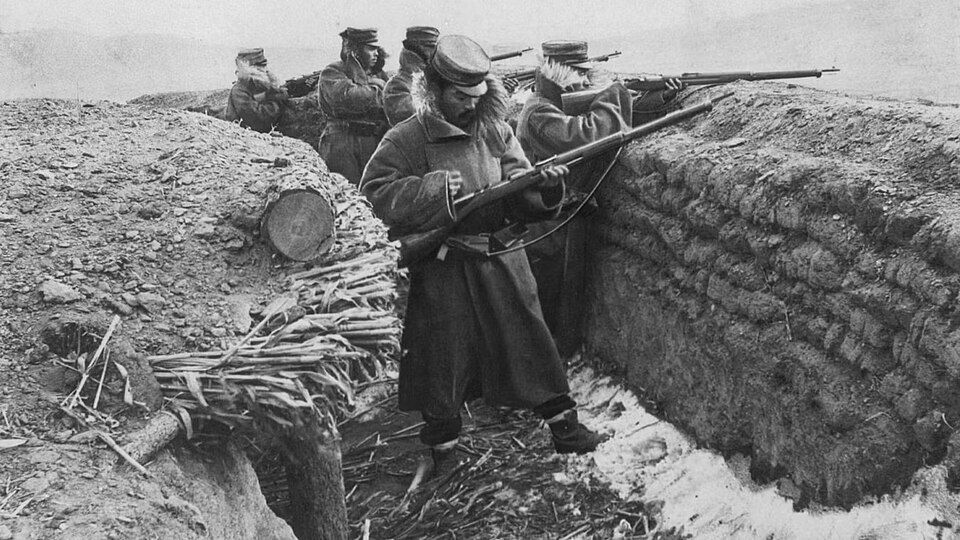
The Russo-Japanese War of 1904 to 1905 should have been the alarm bell. Japanese forces using Hotchkiss machine guns dug in, ranged their fields of fire, and turned Russian infantry charges into corpses by the thousand. The fighting at Port Arthur dragged on for months because frontal assault against entrenched automatic weapons did not work. The defenders held. The attackers died.
European observers watched it happen and largely shrugged. They blamed Russian incompetence. They blamed the unique geography. They concluded that real European armies, with real European élan, would still carry the day on the offensive.
The doctrine that ruled the French and British staffs going into 1914 was called the cult of the offensive. Bayonet charges. Brightly colored uniforms in some cases. Officers leading from the front on horseback. The conviction that morale and aggression would always defeat firepower if the will was strong enough.
In August 1914, that conviction met an MG 08.
The opening months of the war produced casualty counts that nobody on either side had prepared for. French infantry in red trousers and blue coats walked into German machine gun fire across open fields and were cut down in their tens of thousands. The British Expeditionary Force, the most professional army on the continent, was effectively destroyed within months of arriving in France. By Christmas, the survivors had dug in from the Belgian coast to the Swiss border, and the war that everyone said would be over in months had become a static, industrialized killing machine that nobody knew how to break.
The Arsenals of the Trenches
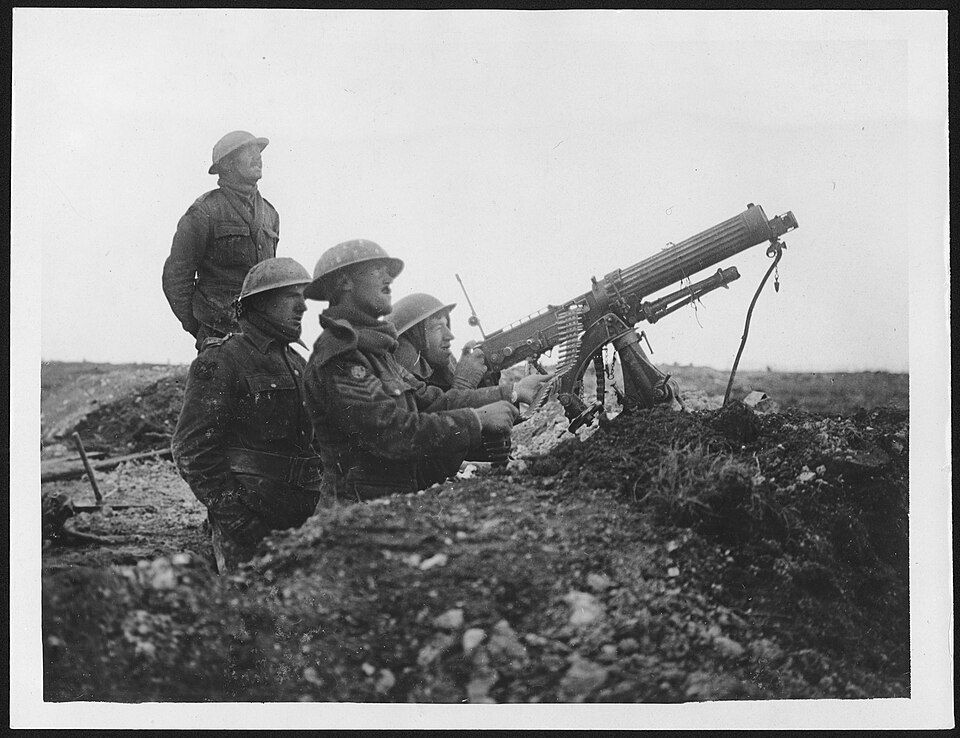
Every major combatant brought a slightly different machine gun to the war, but the underlying logic was the same: anchor the line, channel the enemy into prepared killing zones, and let the math do the work.
The German Army fielded the Maschinengewehr 08, a direct evolution of Maxim’s original design chambered in 7.92x57mm Mauser. The MG 08 was a beast. Gun body alone weighed 58 pounds. Mount it on its Schlitten 08 sled-style mount and add the cooling water and you were looking at 152 pounds of steel and brass to be carried, dug in, and ranged before contact. It fired 450 to 500 rounds per minute. The Germans were also the first to figure out the tactical organization. Where the French and British initially scattered their machine guns across infantry battalions in penny packets, the German Army centralized them at the regimental level, grouped in batteries that could deliver concentrated, mutually supporting fire. That decision is what made German defensive doctrine so brutal in 1914 and 1915.
The British Army carried the Vickers Mk I, adopted in 1912. A Vickers was a Maxim with the rough edges polished off. It was lighter, with a system weight in the 33 to 51 pound range depending on how you counted the tripod and the water. It used a gas boost at the muzzle to assist the recoil cycle, which improved reliability significantly. Chambered in .303 British, fed by a 250-round canvas belt, the Vickers became famous for the fact that it almost never broke. By October 1915 the British had figured out what the Germans already knew and stripped Vickers guns out of standard infantry units to form a centralized Machine Gun Corps.
The French Army’s primary heavy machine gun was the Hotchkiss M1914, chambered in 8mm Lebel. The Hotchkiss was gas-operated rather than recoil-operated, and it was air-cooled. Instead of a water jacket, it had a series of thick brass radiator rings around the barrel to absorb and dissipate heat. It fired 600 rounds per minute, the highest rate of fire among the heavy guns, and the AEF would eventually buy more than 9,000 of them when the Americans had to equip themselves out of French inventory.
The American answer, when it finally arrived, was the Browning M1917. John Moses Browning had designed a recoil-operated, water-cooled .30-06 machine gun in 1900 and waited seventeen years for the Army to take it seriously. When the Browning hit the front in late 1918, it set a new standard. A combat report from the 79th Division documented one detachment of four Browning M1917s firing 13,000 rounds over five days of continuous rain and mud, with a single stoppage caused by a broken ejector. That kind of reliability did not exist in 1914. It existed because four years of slaughter had forced it into existence.
The Geometry of Slaughter
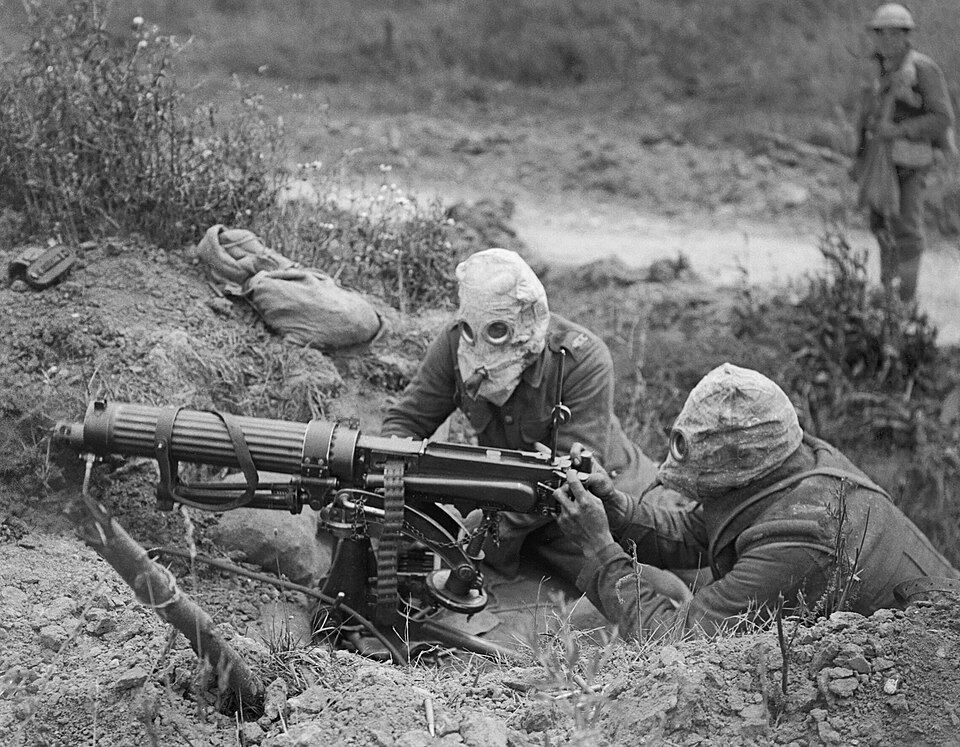
What the machine gun changed was not just the volume of fire but the shape of the battlefield itself. Linear formations and frontal assault were finished. Combat became a question of angles, sightlines, and overlapping arcs.
A machine gun pointed straight ahead at advancing infantry is wasteful. It puts the gun in direct line of sight to enemy artillery and rifle fire, and it is not even particularly lethal, because a line of advancing men only presents one shooter’s silhouette to each bullet. The shape changes completely if you fire from the flank.
This is called enfilade fire. A target is in enfilade when fire travels down its longest axis. A trench fired down its length. A line of advancing infantry shot from the side, so that a single bullet can travel through multiple men. Combine enfilade with grazing fire, where the bullet’s arc never rises above the height of a standing man across the effective range, and you create a wall of lead that does not have any gaps. A man crossing the field is going to walk into the beaten zone of one gun or another no matter which route he picks.
To survive the artillery counterstrike, gun crews sited their weapons in defilade. A gun in defilade is masked from direct enemy observation, hidden behind a reverse slope, dug into a concrete pillbox, sheltered by terrain or by purpose-built fortification. The gunner does not always need to see the target. He needs to be ranged onto a predetermined sector of fire and ready to put rounds into it when the call comes.
Network multiple guns together. Assign each one an overlapping arc of fire. Make sure that if the enemy tries to flank one position, he walks straight into the kill zone of the next. This is the interlocking fields of fire that became the bedrock of trench defense, and the reason the front lines moved a few thousand yards in either direction across four years of fighting.
The gunners themselves were drilled into something close to a religious discipline. The myth that a machine gun on full auto climbs uncontrollably is exactly that, a myth. A properly mounted heavy machine gun, with a gunner in correct cheek-to-stock weld and natural point of aim, holds its trajectory through a sustained burst. Training manuals had crews close their eyes, accept a simulated recoil pulse from a coach, and open their eyes to find the sights still aligned on target. That mechanical stability was the whole point.
Indirect Fire and the Walls of Lead
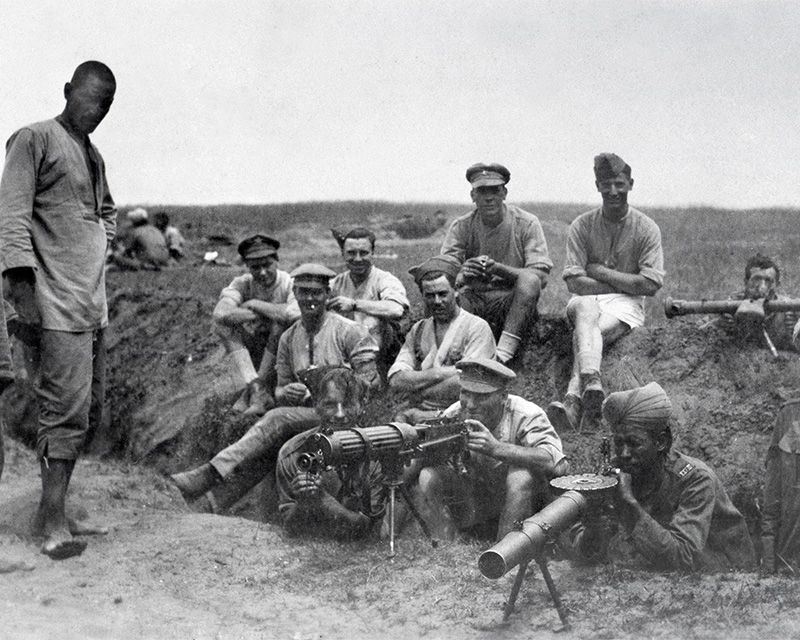
By 1916, the machine gun had evolved past its original role as a defensive infantry weapon. The British figured out that the same gun, fired at high elevation, would arc its rounds over friendly heads and rain them down on enemy positions miles to the rear. The water-cooled heavy machine gun became, in effect, a piece of light artillery.
The math was complicated. Bullets fired at steep angles lose velocity and impact at increasing angles as range increases. At 500 yards, a British .303 Mark VII round produced a beaten zone roughly 220 yards deep and 5 feet wide. Push the range to 1,000 yards and the zone compressed to 140 yards deep. At 1,500 yards, the depth shrank to 70 yards but the width spread to 10 feet. Gunners worked with clinometers, prismatic range finders, dial sights, and slide rules. Aiming posts coated in luminous paint were driven into the ground in front of the guns so crews could fire by night without giving away their positions to muzzle flash.
The defining example is High Wood on the Somme, August 1916. The British 100th Machine-Gun Company emplaced ten Vickers guns in the Savoy Trench. They fired continuously for twelve hours. Approximately one million rounds went downrange to sustain a barrage 2,000 yards in depth. Crews of carriers ran a relay of ammunition and boiling water to keep the guns fed and cooled. Not one of the ten Vickers guns suffered a major breakdown.
A single Vickers, properly served, could project firepower in a way that made the entire idea of a “rear area” provisional. Nowhere within range was safe.
The Quest for Mobility
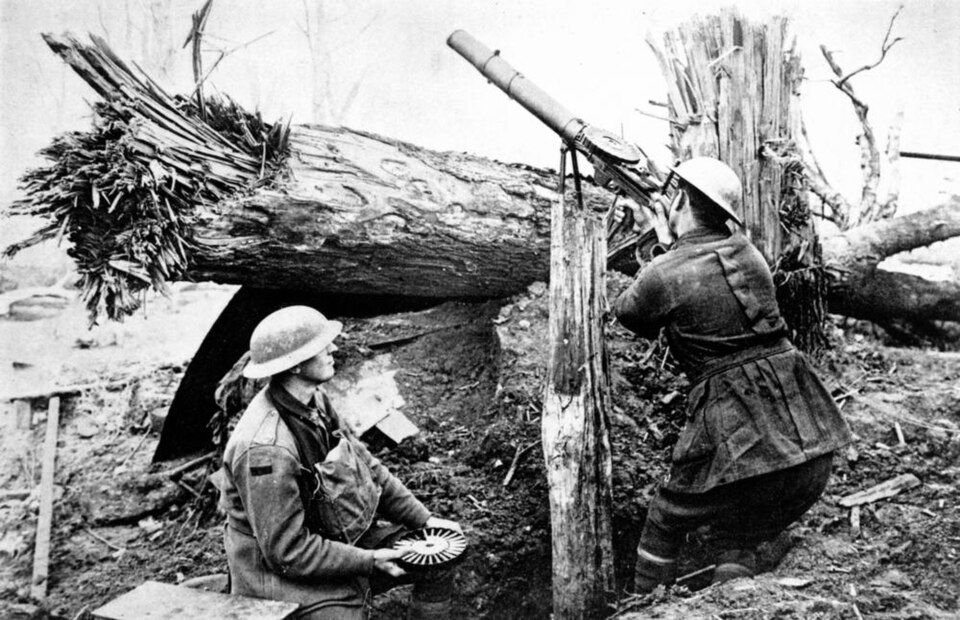
The problem with everything described above is that it works beautifully for the side sitting still. The moment your infantry has to leave the trench and attack across No Man’s Land, those 150-pound water-cooled monsters are useless. They cannot follow the advance. They cannot be set up under fire. And if your attacking infantry actually breaks into the enemy trench, they have nothing to defend it with when the inevitable counterattack arrives.
This is the mobility problem that haunted every army from 1915 onward, and it produced the first generation of light machine guns and automatic rifles.
The French got there first with the Chauchat, a long-recoil weapon chambered in 8mm Lebel. The Chauchat weighed about 20 pounds and could be operated by a two-man team that could keep up with an infantry advance. It became the most widely manufactured automatic weapon of the war. It also developed a reputation for unreliability that was partly deserved and partly the result of a specifically American disaster. When the United States bought Chauchats and re-chambered them in the more powerful .30-06 Springfield, the receivers could not handle the higher pressure. Case head separations, overheating, and mechanical failures became routine. The .30-06 Chauchat was so bad the U.S. Army would not issue it to combat troops and destroyed most of them after the Armistice.
The British and the Allied air services adopted the Lewis Gun, an American design that the U.S. Army inexplicably refused to manufacture for itself. Gas-operated, .303 British, fed from a 47 or 97-round pan magazine mounted on top, with a thick aluminum cooling shroud around the barrel. Lewis Guns ran 500 to 600 rounds per minute. They were heavier than a Chauchat at 28 pounds but vastly more reliable, and they ended up on everything from infantry assault parties to Sopwith Camels.
The pinnacle of the category was the American Browning Automatic Rifle, the BAR M1918. Browning again. Gas-operated, air-cooled, .30-06, 20-round detachable box magazine, 16 pounds. The BAR was specifically designed for a doctrine called walking fire, where an infantryman slings the weapon at his hip and advances across No Man’s Land firing controlled bursts to keep enemy defenders pinned in their trenches. Whether walking fire was actually a sound idea is a separate debate. What is not in question is that the BAR was the most refined automatic rifle of the war and went on to serve the U.S. military through World War II, Korea, and into early Vietnam.
The AEF Starts from Zero
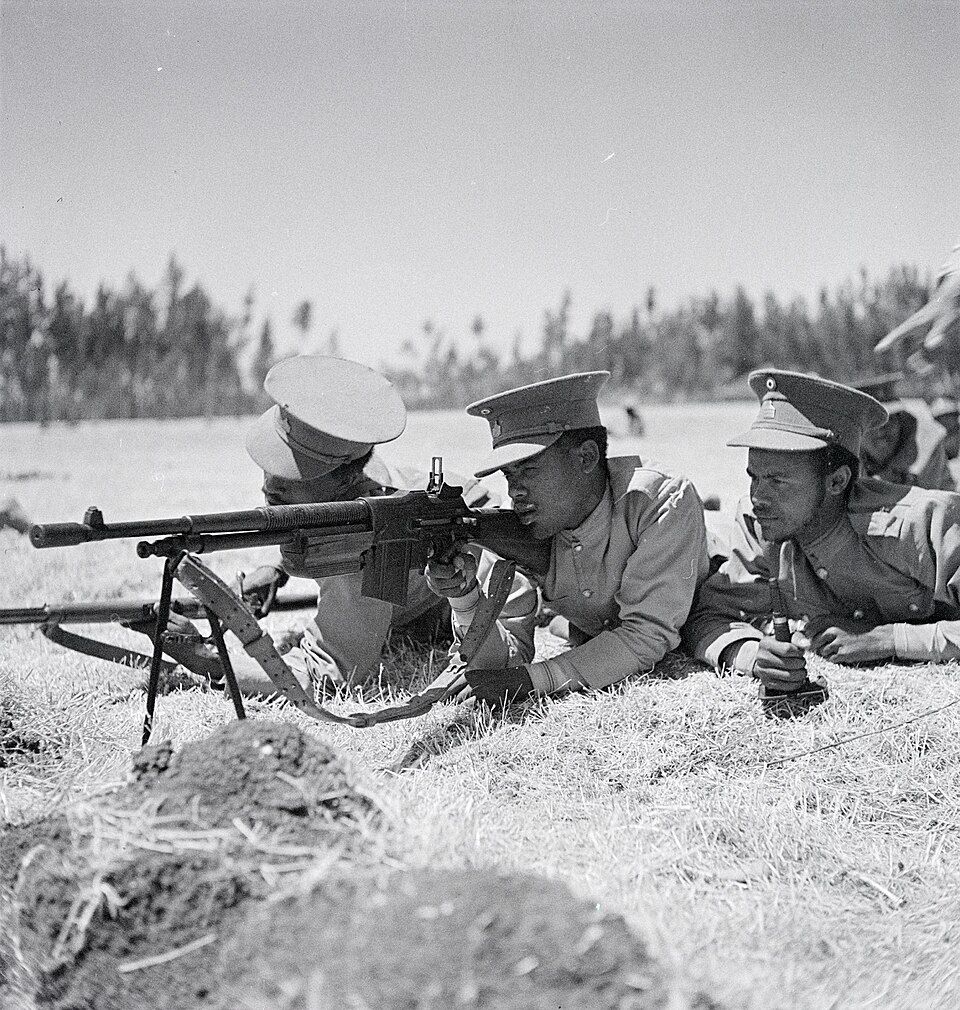
When the United States declared war in April 1917, the U.S. Army numbered roughly 127,000 men. The previous combat experience of most American officers was chasing Pancho Villa across northern Mexico with cavalry. The Army possessed almost no machine guns of any kind.
This is the deficit General John J. Pershing inherited when he was named to command the American Expeditionary Forces. He had to build, in a matter of months, a force that could meet the German Army on the same tactical footing as the British and the French. He bought 9,592 Hotchkiss M1914s from the French government, prepaid in cash, to equip the first divisions arriving in France.
The standard AEF Square Division was reorganized around machine gun firepower. Each division carried 260 machine guns. Thirty-six of those were dedicated to anti-aircraft duty. The remaining 224 were woven through the infantry organization, with brigade machine gun battalions, regimental machine gun companies, and a separate motorized battalion held in division reserve. The standard heavy machine gun squad was nine men under a corporal, moving a single gun forward via mule-drawn combat cart and then by hand into the firing position.
Training those crews was a separate problem. The AEF stood up specialized schools at Langres and Gondrecourt. At Langres, Marine Corps Major Andrew Drum, who had built the Corps’ first armored car unit in 1916, took command of the Machine Gun Section in early 1918. Drum dropped the unreliable French St. Étienne from the curriculum and built the training pipeline around the Hotchkiss. He moved his detachment to the Courcelles-en-Montagne firing range and eventually pushed more than 4,500 men through advanced gunnery, direct fire integration, and the math of indirect barrages.
There was one more decision Pershing made that mattered. By July 1918, American factories were shipping the new Browning M1917 heavy machine guns and the BAR M1918 to France in volume. Pershing refused to issue any of them to frontline units until September. He was afraid that one captured gun in a minor engagement would let German engineers reverse-engineer the designs and turn them against his own men. So the AEF fought the summer of 1918, including Belleau Wood, with French equipment.
When the Brownings finally went forward at the Meuse-Argonne, they earned the wait.
Belleau Wood and the Argonne
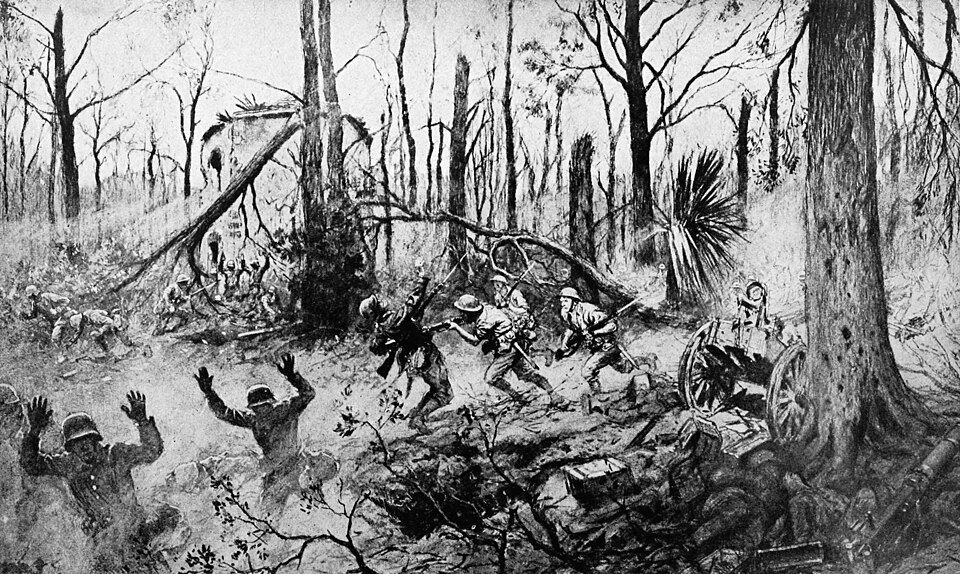
The American crucible came in two phases. The first was Belleau Wood, June 1918. The second was the Meuse-Argonne, September through November.
In late May 1918, the German Spring Offensive had pushed the French Army to the edge of collapse. The U.S. 2nd Division, an unusual hybrid that paired an Army infantry brigade with the 4th Marine Brigade, was thrown into the line near the Marne to stop the bleeding. Their assigned objective was a tangled, rocky hunting preserve called Belleau Wood, fortified by German infantry and machine gun nests sited along the natural defilade of the terrain.
The Marines attacked across open wheat fields directly into MG 08 crossfires. The combat was as savage as anything American troops had ever faced. The German gunners, dug in among boulders and thick underbrush, opened up on the advancing Marines at point-blank range. Survivors of the attacks described a pattern: every silenced German nest had a dead gunner beside it, because the only way to take a machine gun in those woods was to charge it through the bullets and kill the crew with bayonets and trench knives.
Captain Macon C. Overton of the 6th Marines reduced a strong German nest, then pushed forward to capture a field piece that was firing point-blank into his Marines. Private Andrew Champion of the 67th Company watched his automatic rifle gunner, Private Harry Flynn, cut down in the wheat. Champion stepped forward into the same fire, picked up the weapon, and continued the attack. By the time the wood was cleared on June 26, the German Army had given the Marines a name out of grudging respect: Teufel Hunden. Devil Dogs.
The Meuse-Argonne, launched September 26, 1918, was the climax. It remains the largest and deadliest battle in American military history. Over 1.2 million U.S. troops, fighting through ravines, ridges, and dense forest that German engineers had ranged inch by inch for years.
The campaign produced one of the most extraordinary acts of single-handed combat in American history. On October 12, near Cunel, First Lieutenant Samuel Woodfill of the 60th Infantry, 5th Division, found his company pinned down by enfilade fire from three German machine gun positions. Already suffering the effects of mustard gas, Woodfill ordered his men to hold and moved forward alone. He stalked the first nest by terrain and killed the crew with his rifle. He stalked the second and killed five Germans with rifle fire. When he closed on the third, his rifle was empty. He drew his sidearm and jumped into the gun pit. Two German gunners were turning their weapon onto him. He killed them both with a pickaxe pulled out of the mud.
Woodfill received the Medal of Honor. Pershing later called him the outstanding soldier of the entire AEF.
A few weeks later, on November 3, Captain Marcellus Chiles of the 356th Infantry led his battalion across a waist-deep stream near Le Champy Bas under heavy machine gun crossfire. He was mortally wounded in the water, refused evacuation, gathered his remaining troops, and continued to direct the assault until the objective was taken. He turned over command minutes before he died, and received the Medal of Honor posthumously.
Even on the final night of the war, November 10, the 2nd Engineers built foot bridges across the Meuse River under continuous machine gun fire so the 5th Marines could cross. The Armistice took effect at the eleventh hour of November 11.
The Inheritance
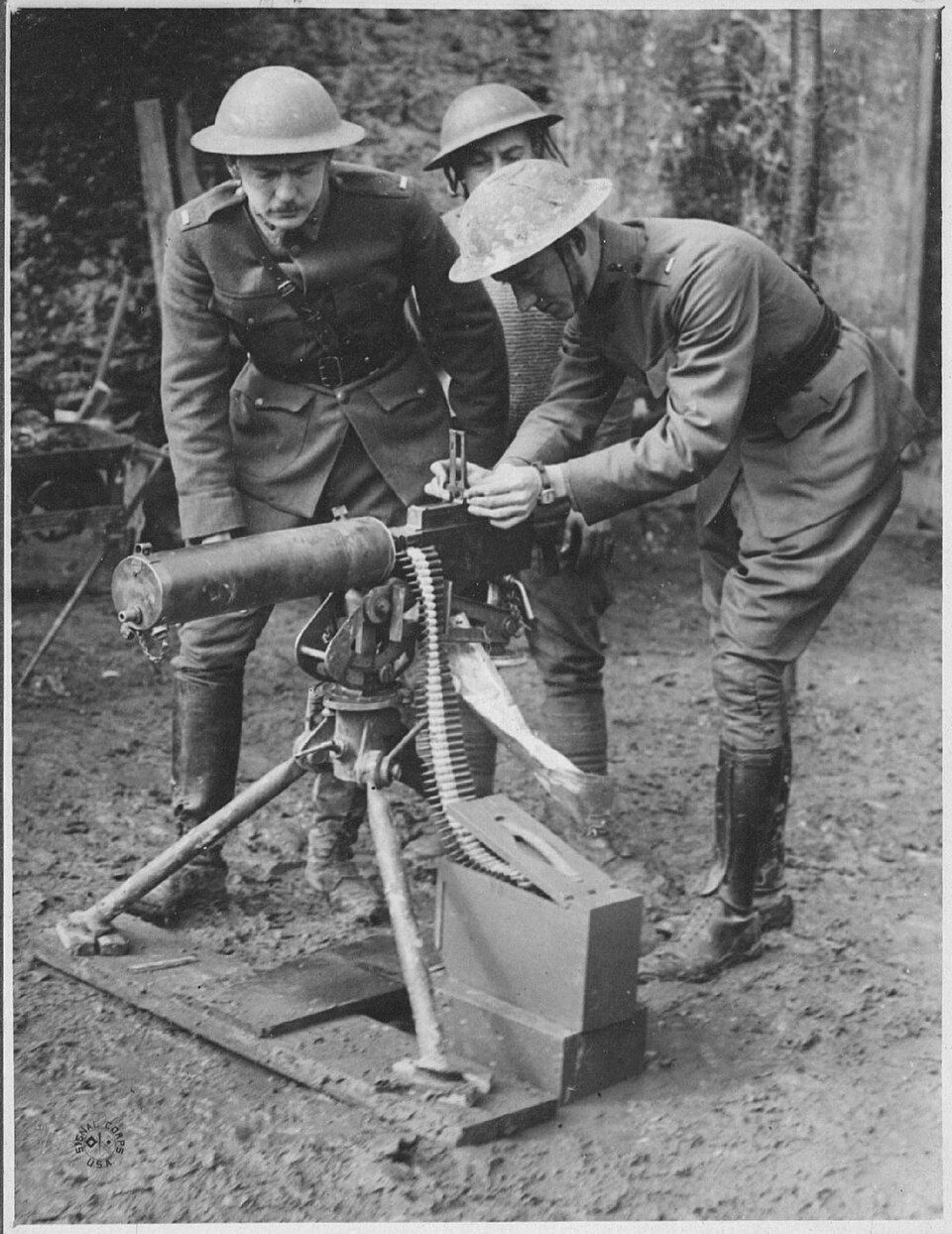
What the machine gun did to infantry combat between 1914 and 1918 is the foundation of every modern doctrine you can name.
Fire and maneuver. Base of fire elements supporting flanking assaults. Suppressive fire as a tactical concept distinct from killing fire. The squad automatic weapon. The tripod-mounted general purpose machine gun in defensive overwatch. The integration of indirect fire support with the infantry advance. Every one of these ideas got worked out in blood by the men who survived the first wars where the machine gun ruled the field.
The doughboys, the slang American infantry of 1917 and 1918 wore as a badge of honor, were the generation that closed that loop. They arrived late, paid disproportionately for the lessons everyone else had already learned, and pushed the war over its final edge with American industrial firepower and the willingness to charge MG 08 nests with bayonets when there was no other way through.
The weapon you carry today owes them. The doctrine you train under owes them. The fact that “machine gun” is a category of weapon every modern military takes for granted owes them.
They held the wheat fields and the forests when the wheat fields and the forests were the worst places on earth to be.
Hard to Kill. Forever Free.
Learn more about the American Warrior 250 Series here.
Related Posts

When the United States declared war on Germany in April 1917, the U.S. Army had 127,000 men, no division structures, and no formal sniper doctrine. This is the story of two flawed scopes, a metallurgical nightmare, and an Arkansas duck hunter who outshot all of it with iron sights.

The StG 44 was the world's first true assault rifle. We break down how Hugo Schmeisser's intermediate cartridge concept changed infantry combat forever, and how its logic runs directly from WWII to the M4 carbine American soldiers carry today.

In 1954, Eugene Stoner set out to solve a problem the U.S. military had been avoiding for years. What he built became the most influential infantry rifle platform in history — and it nearly failed in the jungles of Vietnam before it ever got the chance to prove itself. This is how the M16 went from congressional scandal to the rifle that defined American infantry combat for six decades.

A Colorado company, born on the 4th of July, 2018
Helpful Links

Join the Revolution
Join our e-mail newsletter for giveaways, hot deals, and Swampfox news.
©2026 Swampfox Optics. All rights reserved.
Designed and powered by WebriQ.