
The First Assault Rifle: The StG 44
04/21/2026

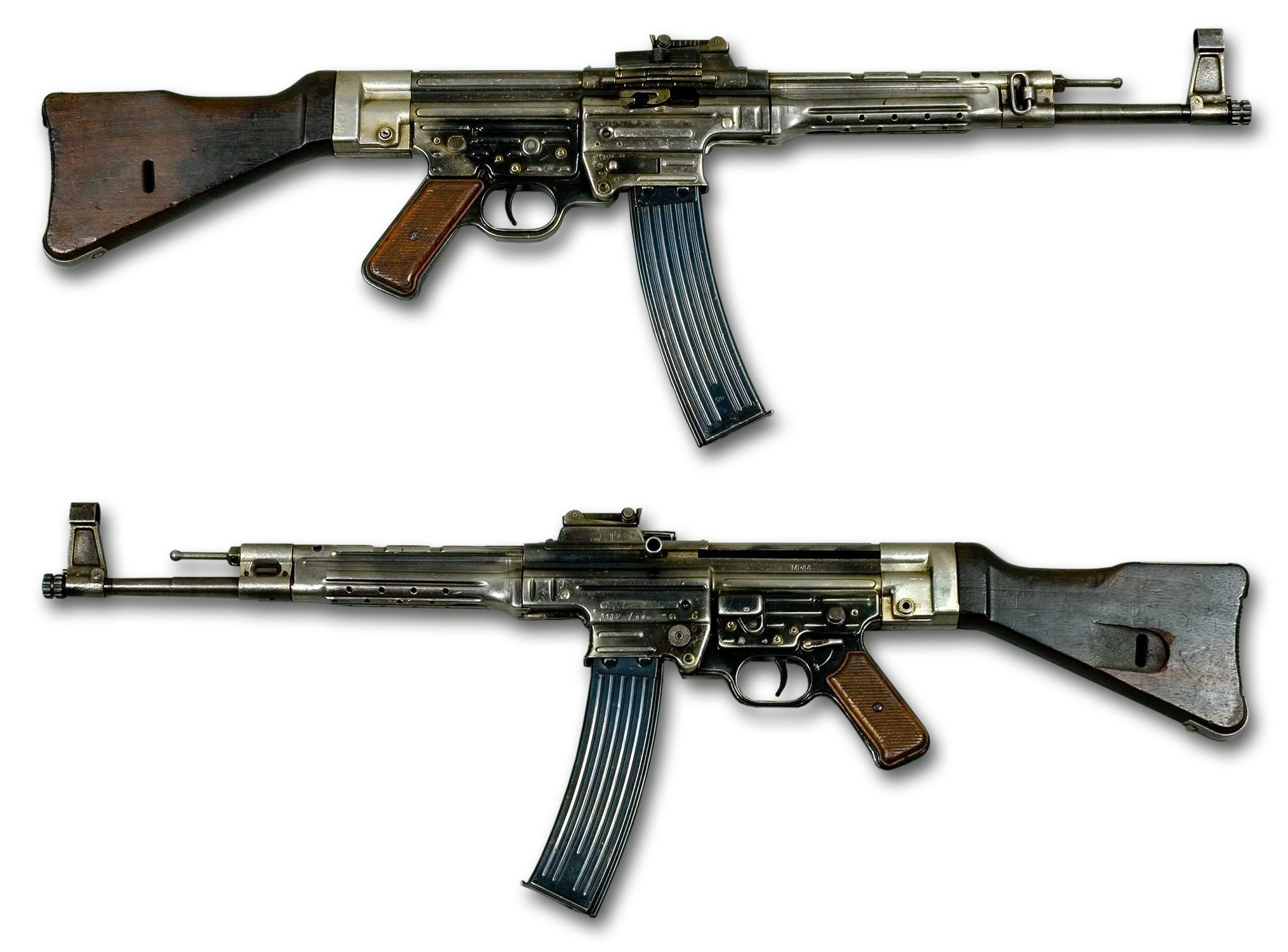
The rifle in your safe right now owes something to a German factory in Suhl, 1943.
Not the action. Not the caliber. The concept. The idea that a soldier in a firefight needs neither a heavy bolt-gun engineered to kill at 800 meters nor a pistol-caliber bullet hose effective to 100. He needs something in between. Enough range to fight across the distances that infantry combat actually happens. Enough volume of fire to suppress and close with the enemy. One weapon that does both.
That idea had been around for years. The StG 44 was the first weapon to get it right.
When American and Allied soldiers first encountered it on the Eastern Front after its capture and analysis, and then in the hedgerows and forests of Western Europe, they recognized immediately that they were looking at something different. Not an upgrade. A new category. The Germans had invented the assault rifle, and every infantry weapon produced in the 75 years since traces its logic back to that decision.
The Gap Nobody Had Solved
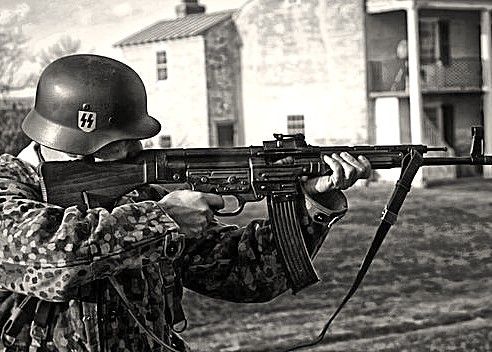
In 1940, the standard infantry engagement had two primary weapons. The bolt-action or semi-automatic rifle fired a full-power cartridge, something in the range of 7.92x57mm Mauser or .30-06 Springfield. It was accurate to 500 meters and beyond. It was also heavy, the recoil made sustained automatic fire impossible, and most soldiers never engaged at the ranges the cartridge was designed for. Studies conducted during World War II established that the overwhelming majority of infantry combat happened inside 300 meters. For the average foot soldier in a firefight, the long-range ballistic performance of a full-power rifle cartridge was irrelevant.
On the other end was the submachine gun. The MP 40, the Thompson, the Sten. Pistol-caliber, high rate of fire, manageable in close quarters. Accurate to about 100 meters in trained hands, and only marginally effective beyond 150. Good for clearing a building. Useless in an open field.
Between those two weapons was a gap. The Germans identified it, studied it, and set out to fill it.
The Intermediate Cartridge
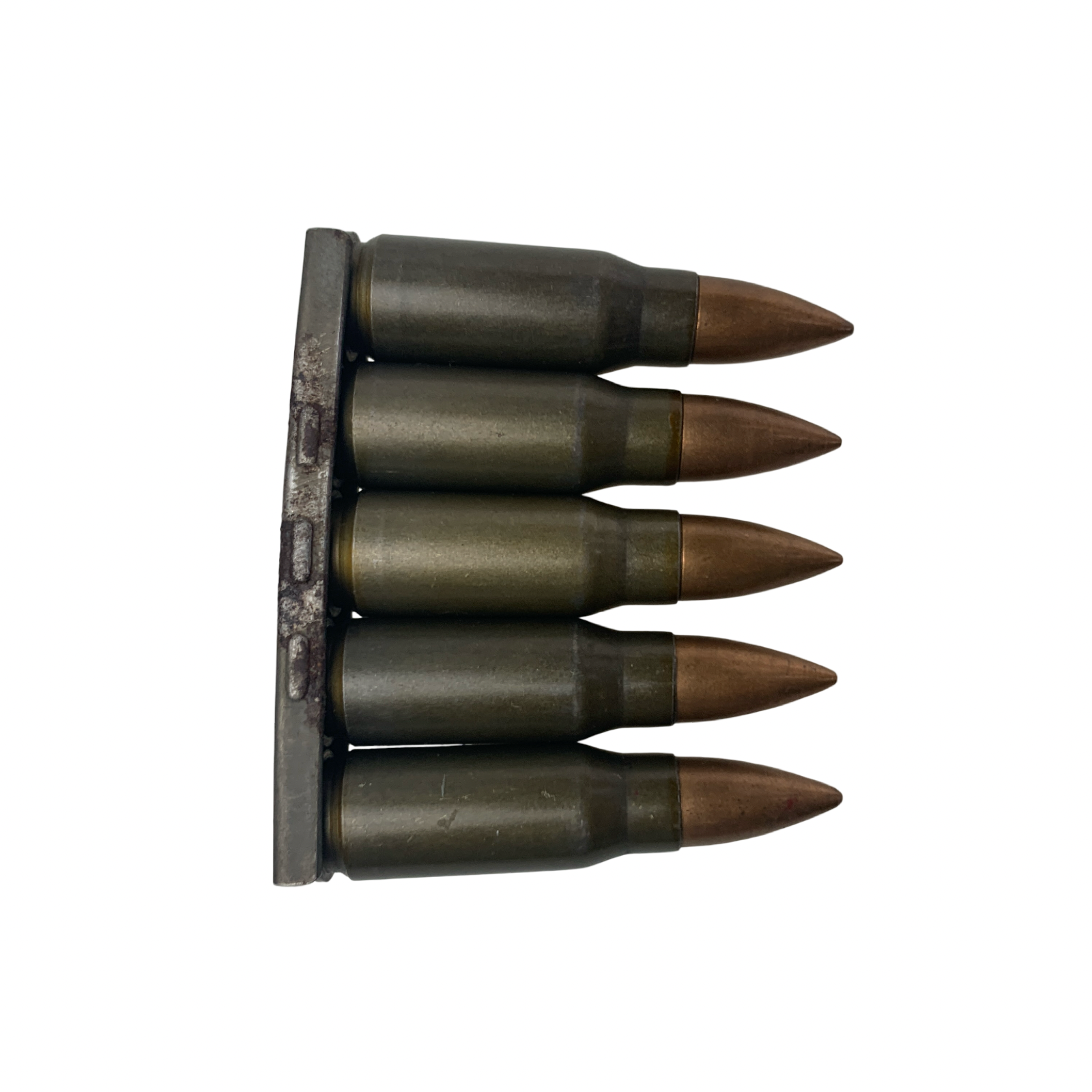
The solution started with the ammunition. In the late 1930s, German ordnance engineers at Polte Werke in Magdeburg developed the 7.92x33mm Kurz, meaning short. It used the same projectile as the standard 7.92x57mm service round but fired from a shorter, lower-powder case. The result was a cartridge that delivered adequate terminal performance and manageable recoil to about 300 meters, the range where most infantry combat actually occurred, at roughly half the chamber pressure of the full-power load. You could design a selective-fire weapon around it. You could carry significantly more ammunition. The physics worked.
The cartridge was the invention. Everything that followed was engineering.
Hugo Schmeisser and the Mkb 42
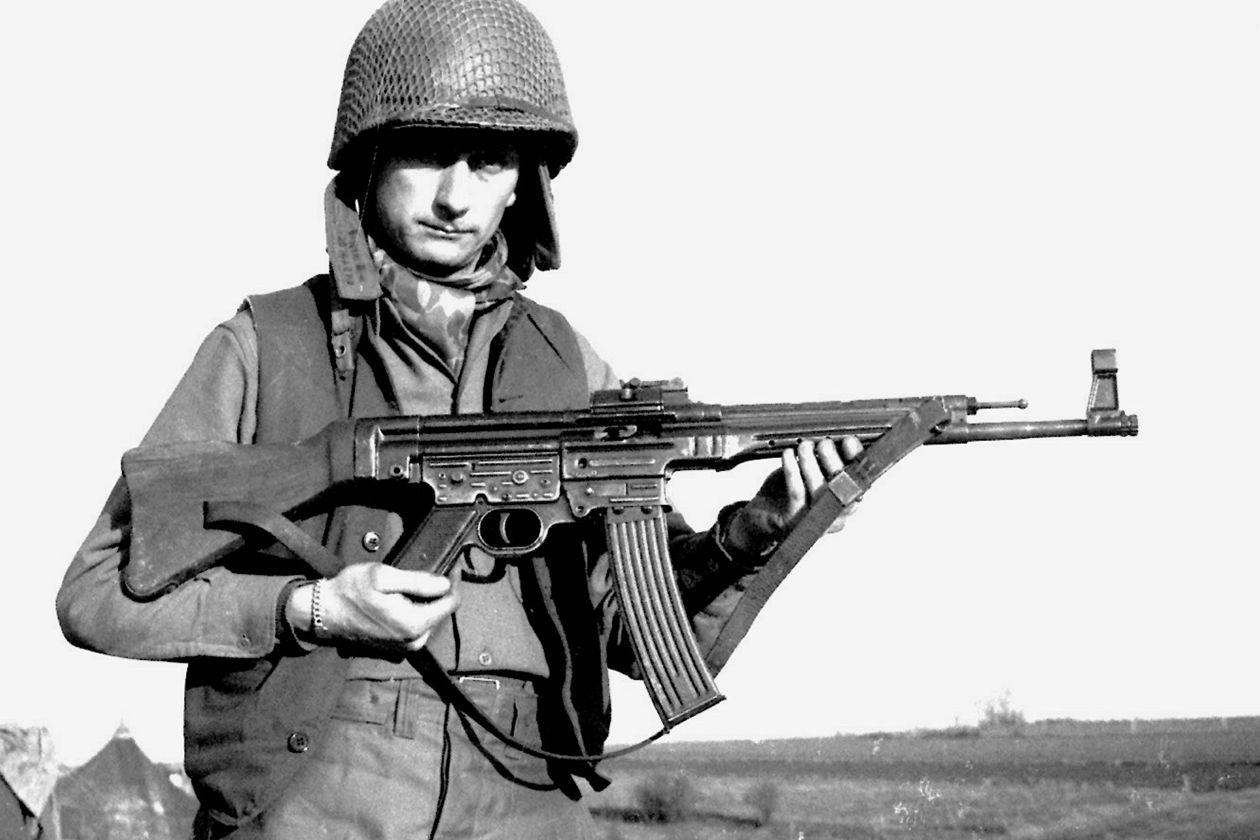
Hugo Schmeisser was a weapons designer at C.G. Haenel in Suhl, a town that had been making firearms since the 17th century. He had already designed the MP 18, the world's first practical submachine gun, during World War I. In the early 1940s, the German Army issued a development contract for a new select-fire carbine chambered in the Kurz round. Haenel competed against Walther. Both submitted prototypes designated the Mkb 42.
Schmeisser's Mkb 42(H) won. The Army ordered field trials in small numbers on the Eastern Front in 1942. The feedback came back positive. Soldiers reported they could engage Soviet infantry at ranges where the PPSh-41, the Soviet submachine gun that had been devastating German forces at close range, was ineffective, while still maintaining the volume of fire needed to suppress and advance.
The weapon worked. The problem was the man at the top.
The Deception
Hitler had already rejected the intermediate cartridge concept. He believed the full-power rifle cartridge was non-negotiable and had been dismissive of the development program. When Army Weapons Office officers continued pushing the project forward despite his directive, they named the weapon the Maschinenpistole 43, MP 43, a submachine gun designation. Hitler saw the paperwork and signed off without recognizing it for what it was.
Production ramped up. Soldiers on the Eastern Front received the weapon and reported the results. By 1944, Hitler had seen enough to recognize the deception and also the results it was producing. He reversed himself. He renamed the weapon the Sturmgewehr 44, Sturmgewehr meaning assault rifle, literally storm rifle. He reportedly said he wanted every soldier on the Eastern Front to have one.
The word he chose, Sturmgewehr, is still the name of the category 80 years later.
What It Could Do
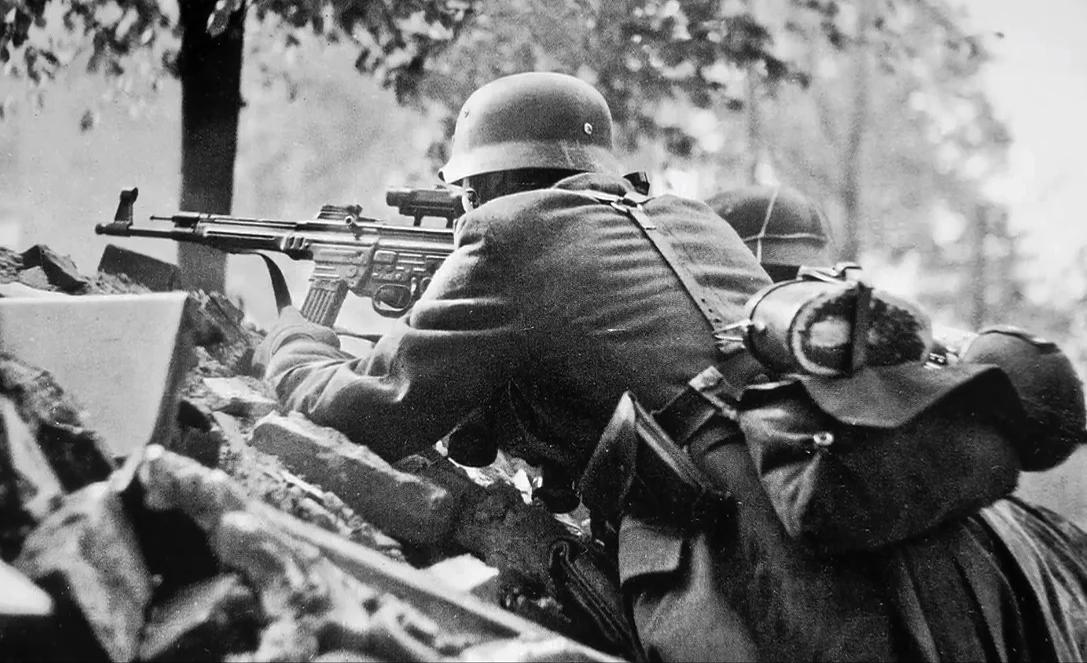
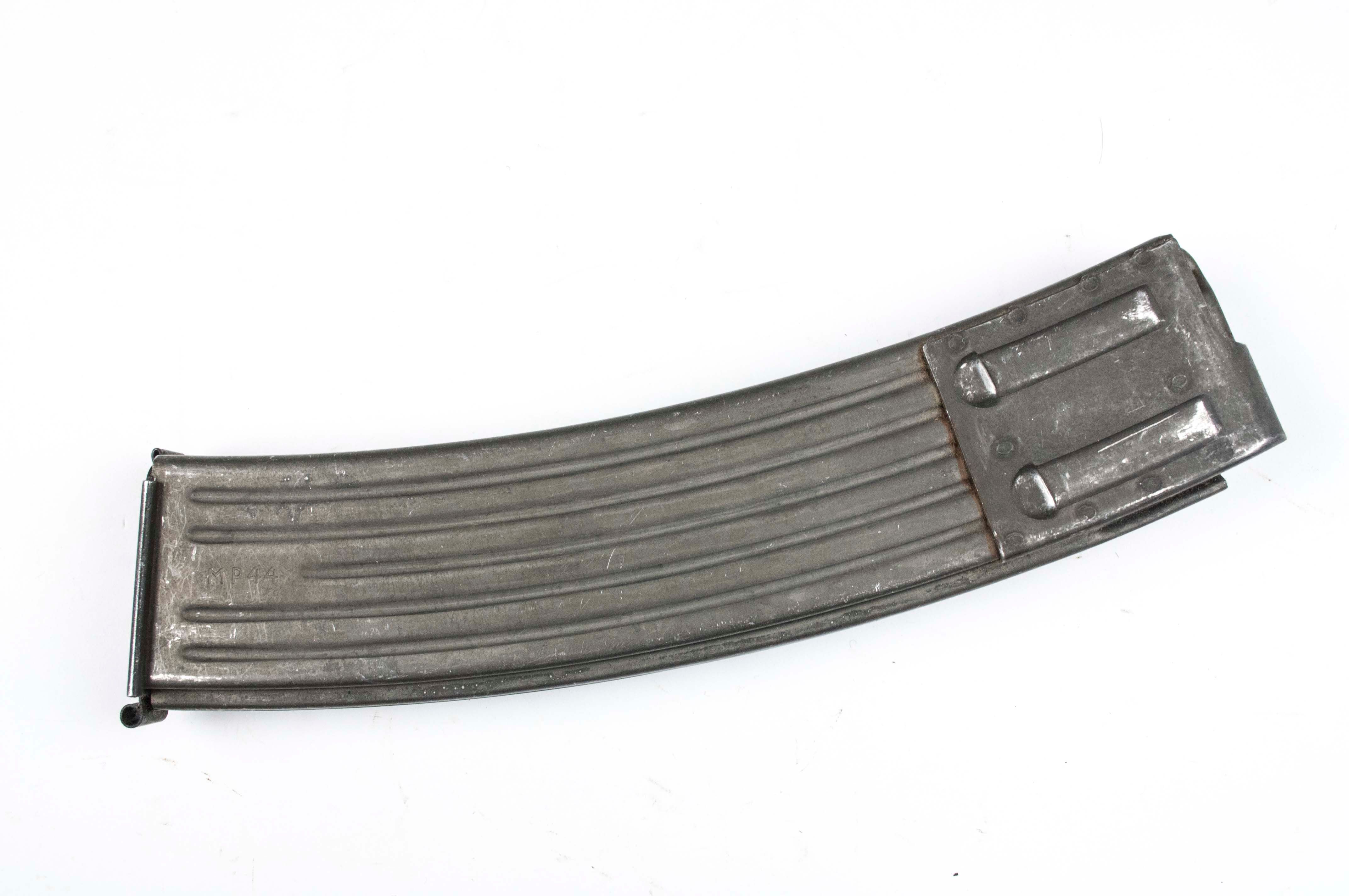
The StG 44 as fielded in 1944 weighed about 10.8 pounds loaded with a 30-round magazine. It was gas-operated with a tilting bolt, fired from a closed bolt in semi-automatic mode, and produced a cyclic rate of roughly 500 to 600 rounds per minute on full auto. Effective range in semi-automatic fire was approximately 300 meters. Beyond that, the Kurz cartridge lost the energy needed for reliable performance.
What that specification meant in practical terms: a single German rifleman carrying the StG 44 could lay down suppressive fire at ranges that made the Soviet PPSh-41 and MP 40 useless in return, and do it while still hitting individual targets accurately out to distances where a submachine gun was throwing rounds at random. Against American infantrymen armed with the M1 Garand, a semi-automatic rifle in a full-power cartridge, an StG 44 in the hands of a trained soldier was giving up range and precision at distance while dominating the close and medium engagement.
The Germans produced approximately 425,000 before the war ended. Not enough to change the outcome. Enough to change what came next.
What the Allies Took Away
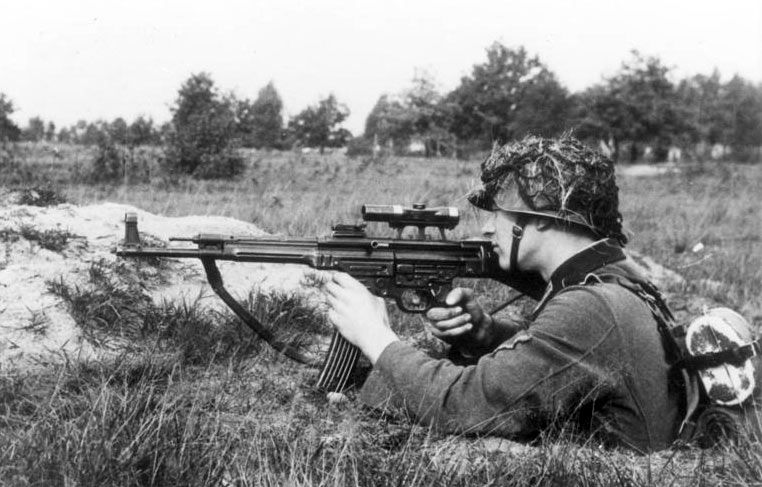
American and British ordnance officers examined captured StG 44s extensively. The analysis was clear. The weapon represented a genuine tactical advancement. The intermediate cartridge concept was sound. A soldier armed with a select-fire weapon in an intermediate caliber, carrying 300 rounds of ammunition at a total load comparable to a rifleman with 120 rounds of .30-06, had more firepower at the ranges infantry combat actually demanded.
The immediate post-war American response was, in retrospect, a detour. The M14, adopted in 1957, was a full-power 7.62x51mm NATO select-fire rifle. It was heavy, the full-power cartridge made sustained automatic fire uncontrollable for most soldiers, and it repeated the same mistake the Germans had tried to solve. The institutional preference for the full-power cartridge, combined with the politics of NATO standardization, overrode what the data from the war had demonstrated.
Vietnam corrected that. The M16, chambered in the new 5.56x45mm intermediate cartridge, went to war in Southeast Asia and eventually replaced the M14. The path from the StG 44's 7.92x33mm Kurz to the 5.56x45mm isn't a straight line, but the concept is identical. Intermediate cartridge. Select fire. High magazine capacity. Lightweight enough to fight with.
Schmeisser and the AK-47
After Germany's surrender, both Allied powers went looking for German engineers. Hugo Schmeisser was taken by Soviet forces and transported to Izhevsk in 1946, where he remained until 1952. Those years overlap exactly with the development and finalization of the AK-47.
Mikhail Kalashnikov always disputed that Schmeisser contributed substantively to his design. The historical record is incomplete. What is not disputed is that the AK-47 uses an intermediate cartridge, the 7.62x39mm, that sits in exactly the same performance envelope as the Kurz round. It uses a gas-operated tilting bolt. It fires from a 30-round detachable magazine. Whether Schmeisser taught Kalashnikov anything or not, Kalashnikov arrived at the same answers.
The StG 44's conceptual descendants have now been fired in every conflict on earth for 75 years.
The Legacy
The M4 carbine that American soldiers carry today is chambered in 5.56x45mm. It is select-fire. It uses a 30-round STANAG magazine. It weighs roughly 7 pounds loaded. Its effective range against individual targets is about 500 meters, limited not by the weapon's mechanics but by the cartridge's terminal performance at distance.
The StG 44 weighed 10.8 pounds, used a 30-round magazine, and was effective to about 300 meters. The 80 years between them represent improvements in materials, propellants, metallurgy, and manufacturing. The foundational decision, the intermediate cartridge in a select-fire platform, was made by German engineers in the early 1940s.
American forces faced that weapon in combat and recognized it for what it was. Then they spent the better part of two decades arguing about whether to adopt the lesson before Vietnam forced the answer. The M16 was not an American invention built from scratch. It was the American military's eventual acknowledgment that the Germans had gotten something right.
Understanding that history matters because it is how military technology actually works. Not a clean progression from domestic genius to domestic genius, but a grinding competition where every side captures the enemy's weapons, studies them, argues about them, and eventually copies what works.
The StG 44 worked. Everything since is a variation on the theme.
Hard to Kill. Forever Free.

A Colorado company, born on the 4th of July, 2018
Helpful Links

Join the Revolution
Join our e-mail newsletter for giveaways, hot deals, and Swampfox news.
©2026 Swampfox Optics. All rights reserved.
Designed and powered by WebriQ.