
The Line Was the Weapon: The Truth About Musket Accuracy
07/08/2026
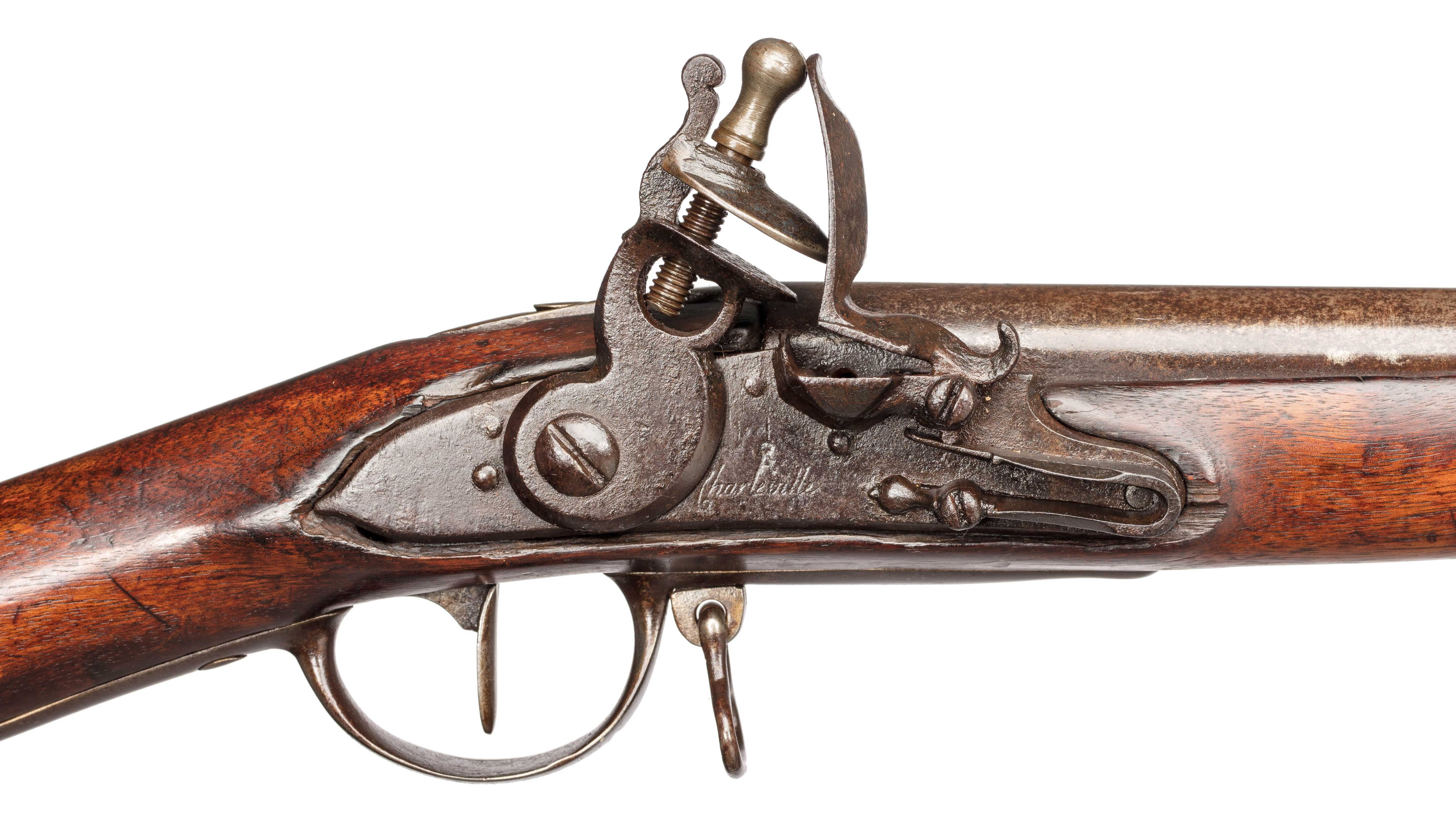
On October 7, 1777, at Bemis Heights, a British brigadier general rode along a collapsing line on a grey horse.
His name was Simon Fraser. He was one of the best field officers Britain had in North America, and John Burgoyne's second attack at Saratoga was falling apart around him. Fraser rode the line in the open, in full view, trying to steady the Hessians and the light infantry and pull the assault back together. As long as he stayed in the saddle, the British still had a chance.
Colonel Daniel Morgan saw him do it. Morgan pulled a handful of his riflemen out of the fight, pointed at the officer on the grey horse, and told them to bring him down.
The distance was roughly 300 yards. At that range a smoothbore musket was not a weapon. It was noise. A line of British regulars could have emptied every barrel they carried in Fraser's direction and hit nothing but dirt and sky.
One of Morgan's men climbed for a firing position, settled a long barrel across a rest, and worked the problem. The first shot cut the crupper strap on Fraser's saddle. Another clipped the horse's mane. His aide begged him to ride out of it. Fraser said his duty kept him where he was. The next shot went through his abdomen. He was carried off the field and died the following morning. The attack came apart, and Burgoyne's army began the road to surrender.
Later generations gave that marksman a name and a double-barreled rifle and a tree to fire from. The men who were actually there and wrote it down called him only an elderly man, or one of the best shots in the corps, or simply a rifleman. The record leaves him without a name.
The shot became famous because almost no one else on that field could have made it. For every other soldier standing in line that day, on both sides, accuracy did not mean aiming at a man 300 yards away. It didn't really mean aiming at all.
The Musket Was Not Built to Aim
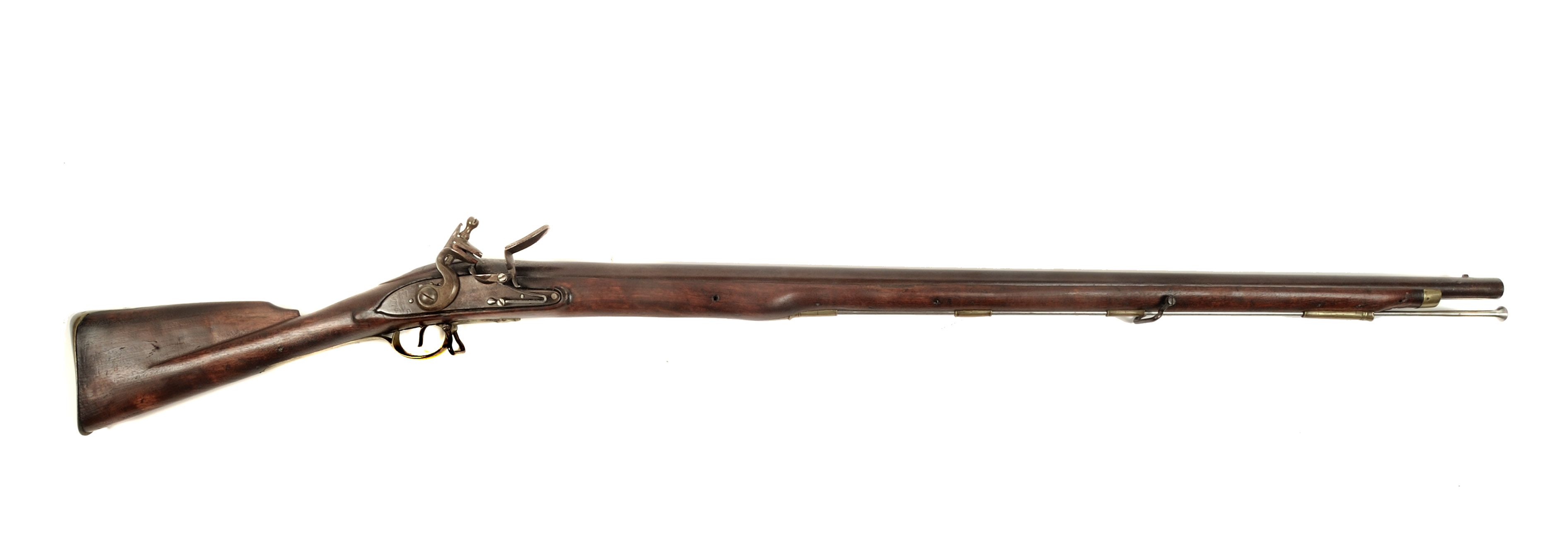
The two guns that fought the Revolution were the British Land Pattern musket, the Brown Bess, and the French Charleville. Both were smoothbore flintlocks. Both were tough, simple, and built to be produced by the tens of thousands. Neither was built to hit a specific man.
Start with the barrel. The Brown Bess had a .75 caliber bore and fired a ball closer to .69. The Charleville ran a .69 bore around a ball closer to .63. That gap between the ball and the bore has a name. It is called windage, and it was there on purpose.
The reason was fouling. Black powder burns dirty. After two or three shots the inside of a barrel cakes with a thick, tarry residue. If the ball fit the bore tightly, a soldier would not be able to ram it home once the fouling built up, and a musket you cannot load is a club. An undersized ball slid down easily even when the barrel was filthy. That kept the gun in the fight.
It also wrecked any hope of accuracy. A loose ball rattles down the barrel when the powder goes off, bouncing off the walls, and comes out the muzzle with a random spin nobody chose. A spinning sphere curves in flight. So the ball left the barrel already committed to drifting somewhere the shooter never intended.
On top of that, these muskets had no rear sight. The Brown Bess used its bayonet lug as a crude front bead and nothing behind it to line the eye up against. You could point the gun. You could not aim it the way we mean the word today.
The Math Nobody Wants to Hear
A calm man shooting a clean musket at a target on a range could do reasonably well out to about 80 yards. Historians and period engineers put the honest effective range against a single man at somewhere between 80 and 100 yards. British Colonel George Hanger, who fought in the Revolution as second-in-command of Banastre Tarleton's Legion, put it more bluntly years later. A musket would hit a man at 80 yards, maybe 100. At 150 the man had to be unlucky. As for firing at a man at 200 yards, Hanger wrote, you may as well fire at the moon.
Now take that range accuracy and drop it into combat. In 1755, Prussian tests fired disciplined grenadiers at a screen the width of an enemy formation. They scored 46 percent hits at 150 paces, under 17 percent at 200, and barely 10 percent at 300. And those were peacetime volleys against a wooden screen that did not shoot back.
Real battles were worse by an order of magnitude. Deafened, blinded by smoke, hands shaking, men rushed their loading, fumbled cartridges, and flinched. The hit rate in actual combat fell to somewhere between one and five percent per volley. At Chotusitz in 1742, the Prussians fired an estimated 650,000 rounds to produce about 5,000 casualties. That is a hit rate under one percent.
So how did anyone win a battle with a gun that missed 99 times out of 100?
You Do Not Aim. You Level.
You stop thinking about the soldier and start thinking about the battalion.
If one ball at 100 yards almost certainly misses a specific man, several hundred balls fired at once into a packed formation will not miss the formation. That was the whole logic of the line. Men stood shoulder to shoulder, two and three ranks deep, and fired together. The unit was the weapon. Each soldier was just one more barrel feeding the wall of lead.
The British drill manual of 1764 did not tell a soldier to aim. It told him to make ready, to present, and to fire. Present was as close as it got to aiming, and the correct word for it was leveling. A soldier brought the butt to his shoulder, kept the barrel level, and sank the muzzle a little. That last part mattered. A heavy powder charge kicked the muzzle up hard, and a line that did not deliberately fire low would send its volley sailing over the enemy's heads. So men were trained to level at the waistbands, even the knees, of the line in front of them. Aim low, fire together, and let the mass do the work.
Then came the part the musket did better than the rifle ever could. Once a volley staggered the other line, the bayonet went in before they could reload. Volley, then steel. That was the formula, and it decided most of the fighting of the era.
Speed Was the Real Skill
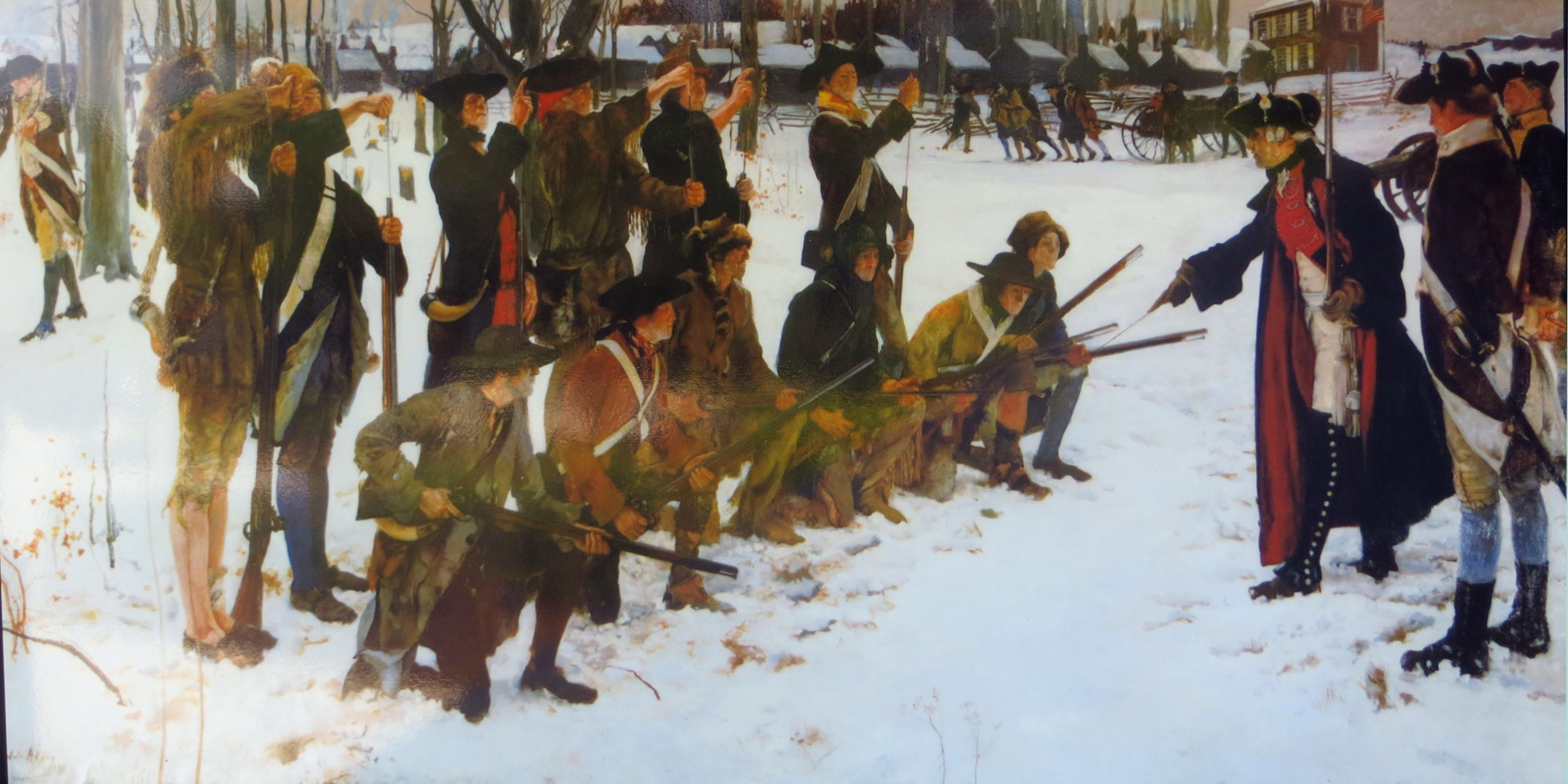
If volume wins, then the fastest-loading army wins. A well-drilled man could fire three to four rounds a minute with a musket. A poorly drilled man might manage two. Put those two units across a field from each other and the faster one simply puts more lead in the air every minute until the slower one breaks. Marksmanship never enters into it.
That is why drill was not busywork. It was the entire game. And it is why the Continental Army's turning point was not a battle at all.
In February 1778, at Valley Forge, a Prussian officer named Friedrich Wilhelm von Steuben took a starving, disorganized army that was loading its muskets a dozen different ways and gave it one way. He took a model company of 100 men, drilled them himself, and used them to train the trainers. He stripped the loading sequence down to its essentials, fifteen motions across eight commands, and hammered it in until it ran on muscle memory. His work became the Blue Book, the manual that ran the American army for decades.
The point of all that repetition was not neatness on a parade ground. It was that a man who has loaded his musket ten thousand times can keep loading it when the man beside him is screaming and the smoke has swallowed the field. Drill was what let a soldier keep working while everything around him told him to run. A unit that could fire four disciplined volleys a minute under that kind of pressure would take apart a unit that could manage two.
Hold. Hold. Now.
The other half of discipline was knowing when not to fire.
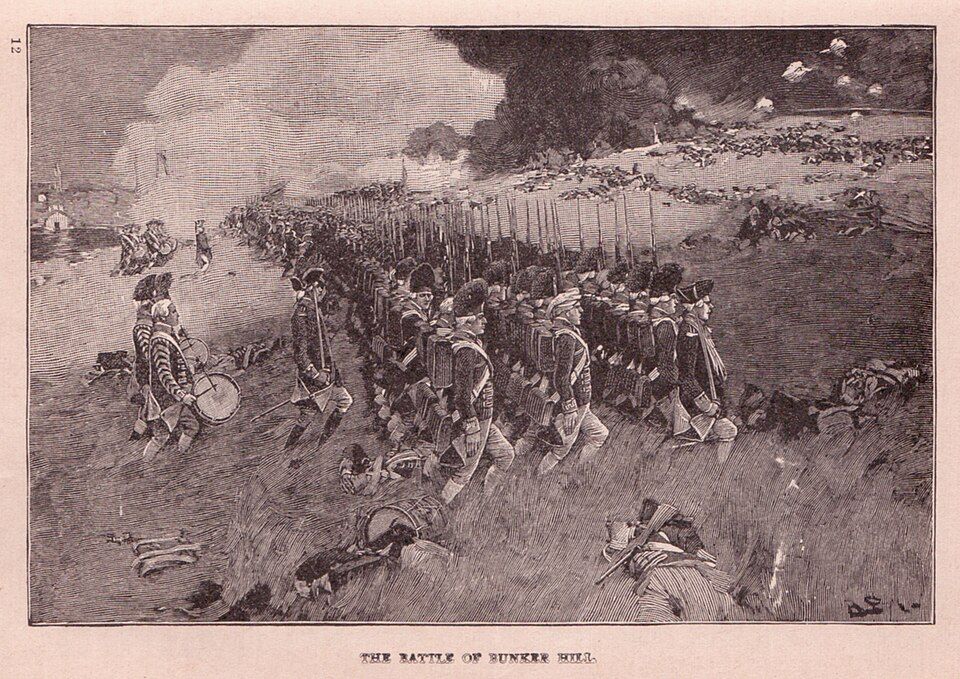
The first volley was the best one a unit would ever fire. The muskets were clean, the flints were fresh, the men were not yet panicked, and the whole line went off at once. Waste it at long range and you traded your one good punch for a cloud of misses. So officers made their men hold, which is a brutal thing to ask of a frightened man watching a wall of bayonets walk toward him.
At Breed's Hill in June 1775, the provincial officers did exactly that. They walked the line telling men to hold, to fire low, to aim at the waistbands, to aim at the handsome coats of the officers. They held their fire until the British regulars were 40 to 50 yards away, and then they tore the front ranks apart.
That was unusually close. Most firefights of the era opened much farther out. At Guilford Courthouse and at Camden the shooting started around 100 to 140 yards, a football field between the lines. Letting the British close to less than half that before firing is what made Breed's Hill what it was. It was not marksmanship. It was nerve.
The Rifle Could Do What the Musket Could Not
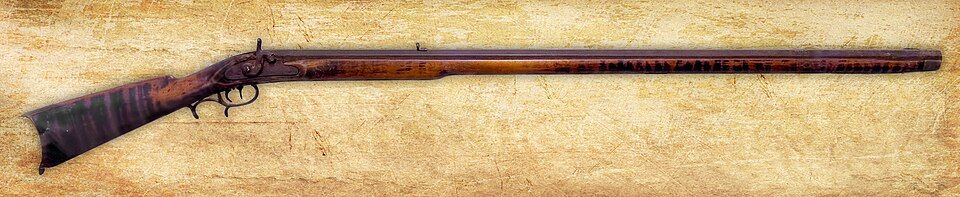
Which brings us back to the man in the trees at Saratoga.
The American long rifle, the Pennsylvania or Kentucky rifle, was a different animal entirely. It was not army issue. It was a frontier hunting gun, built one at a time by gunsmiths, and it was made to do the one thing the musket could not. Its barrel had spiral grooves cut into it. The shooter used a ball that actually fit the bore, wrapped in a greased patch that sealed the gases and gripped the rifling. That spin stabilized the ball the way a thrown football stabilizes, and it flew straight. A good rifleman could hit a man at 200 to 300 yards, the range that killed Simon Fraser.
Washington and his commanders knew what they had. They gathered these frontiersmen into specialized units, the most famous of them Morgan's Rifle Corps, and used them as scouts, skirmishers, and killers of officers. They fought from cover, at distance, on their own terms, well outside the rigid geometry of the line. The shot at Saratoga was the rifle doing precisely what it was for.
So if the rifle was that much more accurate, why did the whole army not carry one?
Because Accuracy Is Not Enough
Three reasons, and every one of them would get a rifleman killed in a stand-up fight.
First, the rifle was slow. The tight-fitting patched ball took real force to seat, and as the grooves fouled, loading got harder, sometimes requiring a mallet to start the ball. A rifleman managed one, maybe two shots a minute against a redcoat's three or four. In a straight exchange of volleys, the rifle unit gets buried under the musket unit's volume of fire.
Second, the rifle had no bayonet. It was a hunting weapon with a slim barrel and no lug to mount one, and it could not take the abuse of hand-to-hand fighting. On this battlefield the bayonet was the closer. When a line of regulars fixed bayonets and charged, an unsupported cluster of riflemen with empty guns and no steel had one option, which was to run.
Third, rifles were expensive. Each one was built by hand, one at a time. You could stamp out identical muskets by the thousand. You could not hand-build a custom rifle for every soldier in the army.
So the rifle stayed what it was. A specialist's tool, deadly in the right hands at the right moment, and useless for holding a line. The musket stayed the backbone of the war.
250 Years of That
Ask how muskets achieved accuracy and the honest answer is that they mostly did not. One man aiming at one man was a coin flip at best and a joke at worst. Accuracy on that battlefield was not a property of the gun or the shooter. It was a property of the unit. It lived in the volume of the volley, the speed of the reload, and the nerve to hold fire until holding it hurt. It was built at Valley Forge in the freezing cold, one repeated motion at a time, long before anyone fired a shot in anger.
The gear has come a long way since a loose ball rattled down a smooth barrel. We have rifling now, and glass, and dots that put the hit where you look. The equipment finally does what those men could only get from standing shoulder to shoulder and trusting the man next to them to reload as fast as they did.
But the thing underneath has not moved. Accuracy was never really about the tool. It was about the training behind it and the discipline to use it when everything in you wants to quit. That was true with a Brown Bess at 40 yards in the smoke. It is true on the range today.
The tools change. That part does not.
Hard to Kill. Forever Free.
Related Posts

Every doctrine you take for granted, fire and maneuver, base of fire, the squad automatic weapon, came out of four years of trial and error in the mud between 1914 and 1918. The machine gun is the weapon that broke infantry combat and forced every army on earth to rebuild it from the ground up.

When the United States declared war on Germany in April 1917, the U.S. Army had 127,000 men, no division structures, and no formal sniper doctrine. This is the story of two flawed scopes, a metallurgical nightmare, and an Arkansas duck hunter who outshot all of it with iron sights.

In 1905, on Samar, a soldier fired four rounds into a prisoner at point-blank range. Three went through the lungs. The man kept fighting. The revolver was a .38, and the Army had traded away its .45 to get it. This is how the Philippines forced that lesson back, and how the road ended at the M1911.

A Colorado company, born on the 4th of July, 2018
Helpful Links

Join the Revolution
Join our e-mail newsletter for giveaways, hot deals, and Swampfox news.
©2026 Swampfox Optics. All rights reserved.
Designed and powered by WebriQ.