
Smoke and Guesswork: How the Spanish-American War Exposed America's Blind Artillery
06/12/2026

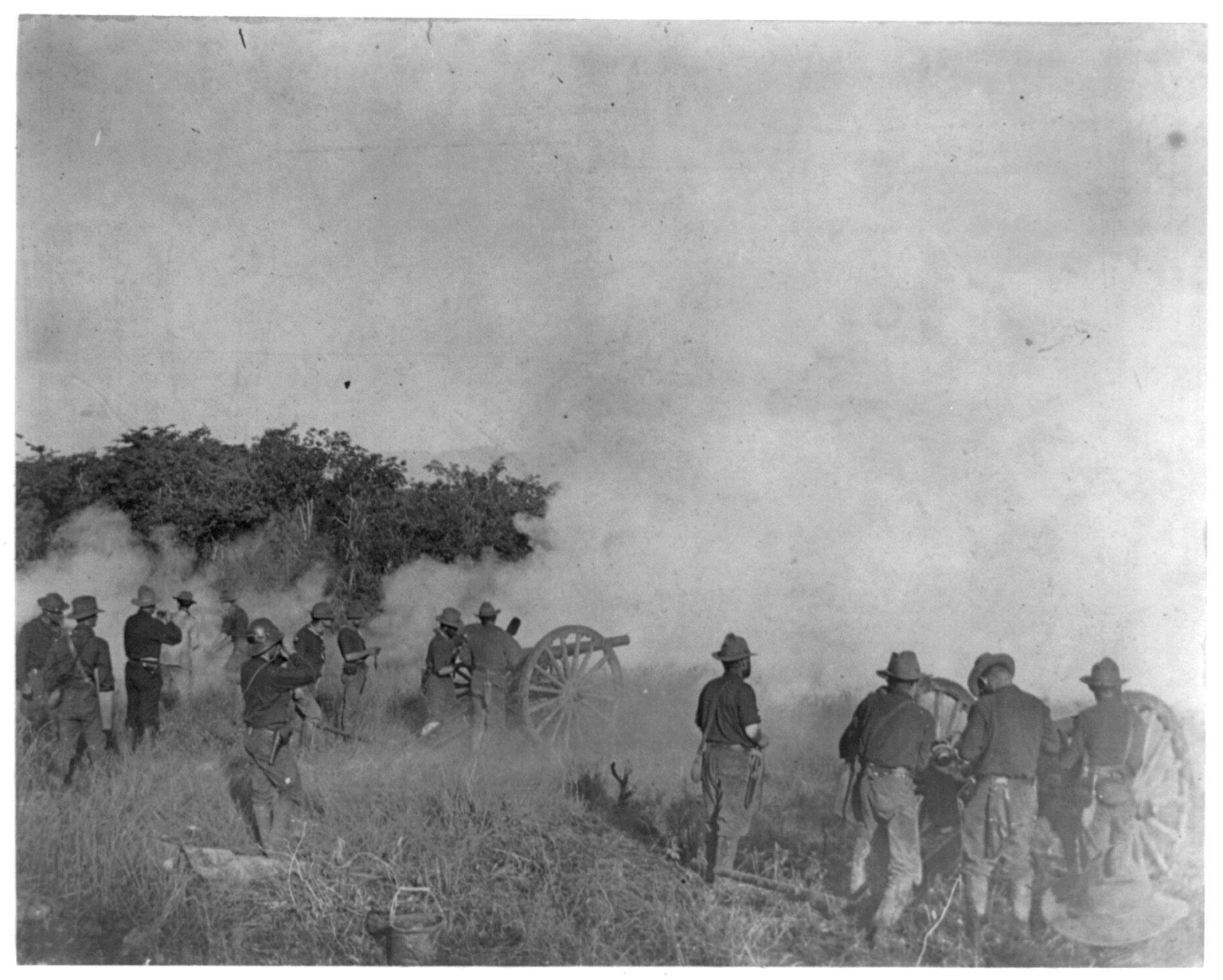
On the morning of July 1, 1898, Captain George S. Grimes opened fire on the Spanish lines outside Santiago. His battery of four 3.2-inch field guns sat on El Pozo hill, roughly 2,400 yards from the enemy heights. The guns burned black powder. Every shot threw up a dense white cloud that hung in the humid jungle air and refused to drift. Within forty-five minutes the Spanish had used those clouds as an aiming point, bracketed El Pozo with two hidden Krupp mountain guns, and rained shrapnel down onto Grimes's crews and the dismounted cavalry staging in the brush below them. The American battery was suppressed and forced to stop firing. The infantry took San Juan Hill and Kettle Hill that afternoon with almost no artillery behind them.
The men won anyway. The guns did not. This is the story of why American artillery in 1898 was firing half-blind, what range finding actually looked like for a gun crew that summer, and how the beating they took in Cuba drove the modernization that built the fire control we take for granted now.
The Gun on the Hill
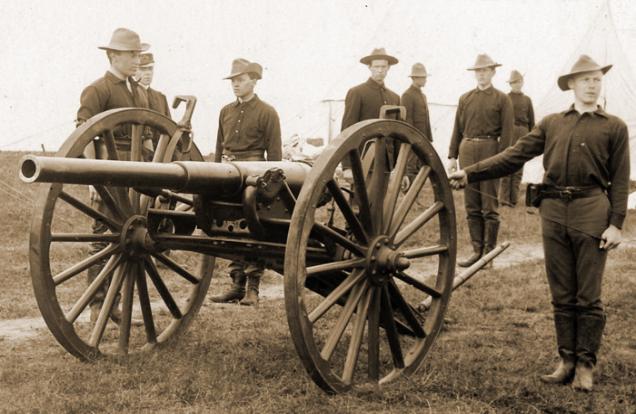
The standard American light field piece in 1898 was the 3.2-inch field gun, a breech-loader that had pulled the Army out of the Civil War era of muzzle-loading smoothbores. It came in three variants, the M1885, the M1890, and the M1897. The improved steel M1897 was the one the Army wanted in Cuba. It was the one the Army did not get. The 262 M1897 guns ordered before the war were held up by manufacturing delays at the Army Gun Factory and by the budget damage from the Panic of 1893, and they arrived after the fighting with Spain was over. The batteries that landed in Cuba fought with the older wrought-iron M1885 and M1890 pieces.
Those guns had a single mechanical flaw that shaped everything that followed. They had no recoil mechanism. The carriage was rigid. When the gun fired, the full force of the recoil drove the 2,130-pound weapon backward across the ground, and the six-to-eight-man crew had to manhandle it back into position and re-aim it before they could fire again. That dropped the practical rate of fire to one or two rounds a minute. A gun that slow cannot suppress a trench. It can only announce where it is and wait to be answered.
The Propellant That Gave Everyone Away
The deeper problem was the powder. In 1898 American field artillery still ran on black powder. The Ordnance Department had understood the case for smokeless powder since the late 1880s, but early nitrocellulose formulas degraded in storage and posed real safety risks, and a stable, mass-producible smokeless artillery propellant was not in the supply chain when the war broke out.
Black powder burns dirty. Roughly 55 percent of the reaction comes out as solid byproduct, and when that hits the humid air it produces thick, opaque white smoke that hangs and spreads. For a rigid-carriage gun that has to be re-aimed after every shot, that smoke was a double penalty. First it blinded the gunners, who had to wait for the wind to clear their own cloud before they could reacquire the target, slowing an already slow gun. Second, and far worse, the smoke plume marked the battery's exact position for every Spanish gunner on the field. Each shot was a flare fired over the crew's own heads.
What Range Finding Actually Looked Like
American artillery in 1898 fought under a strict doctrine of direct fire. The crew had to see the target and aim straight down the barrel at it. Indirect fire, the practice of dropping shells on an unseen enemy using firing solutions, forward observers, and aiming points, was not part of American doctrine at all.
So range estimation came down to the battery commander's eye and a process called bracketing. He would judge the distance, order a round, watch where it fell, see whether it landed long or short, and correct the elevation for the next one. Rudimentary range tables existed that matched barrel elevation to distance for the 3.2-inch gun, but without panoramic telescopic sights and with the requirement to keep the target in direct view, batteries had to set up on exposed forward crests where everyone could see them, including the enemy.
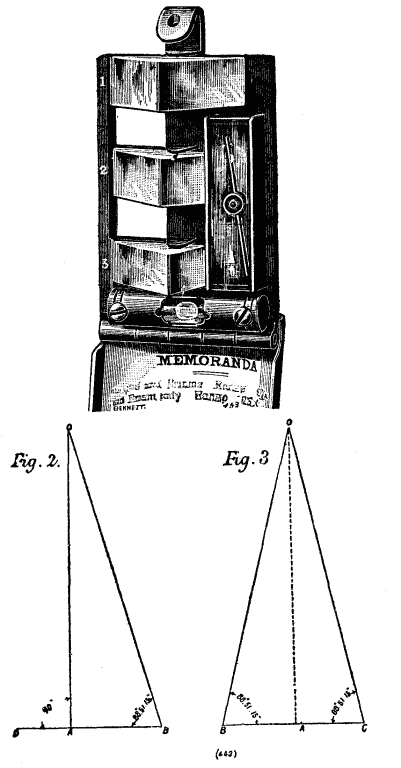
The Army did issue an instrument. The Weldon Range Finder was a small pocket device holding three glass prisms ground to precise angles, and it worked by physical triangulation across the battlefield. The officer would sight a target through one prism against a marker placed at a right angle, then pace backward along a baseline until target and marker lined up in the second prism, which was ground so the distance he walked equaled exactly one-fiftieth of the range. Multiply the paced baseline by fifty and you had the distance.
The math was sound. The method was useless under fire. It needed flat, open ground to pace a baseline, it took time, and it forced the officer to walk sideways and backward across an exposed field while someone was shooting at him. In the broken jungle and ridges around Santiago, U.S. battery commanders mostly abandoned the Weldon and went back to estimating by eye and walking shots onto the target.
How a Range Finder Is Supposed to Work
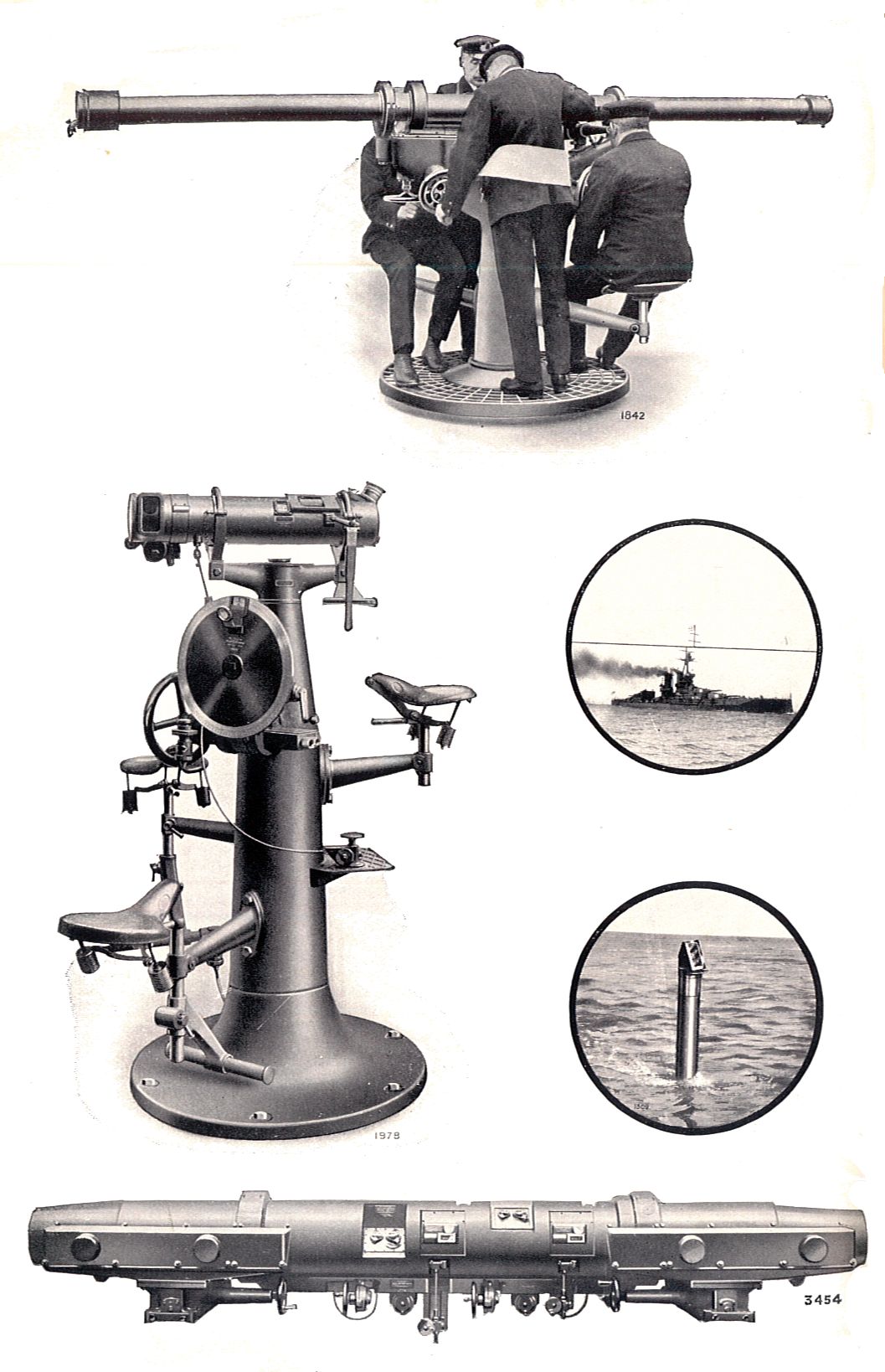
The instruments that actually solved this problem in the 1890s were optical, and they were being driven by naval gunnery, where rifles were reaching past 3,000 yards and eyeball estimates no longer cut it. They worked on triangulation using a fixed baseline built into the instrument itself.
A coincidence range finder is a single long tube with a lens at each end, which sets the baseline. Prisms inside route both images to one eyepiece, where the operator sees the target split into an upper and lower half. He turns a dial that pivots the prisms until the two halves snap into alignment, into coincidence, and the dial reads the range off a scale that converts the prism angle into yards. The longer the tube, the longer the baseline, and the more accurate the reading at long range.
A stereoscopic range finder looks similar but works on human depth perception instead. The operator views the target through two eyepieces alongside a built-in reticle marked with depth steps, and adjusts until the target and the reticle sit at the same apparent depth. It could be extremely accurate, even against targets with no clear vertical edge like smoke or aircraft, but it demanded operators with rare natural depth perception and serious training, which limited how fast anyone could adopt it.
The world's best navies were already moving. The Royal Navy had standardized on the Barr & Stroud coincidence range finder. The U.S. Navy went into the war leaning on the inventions of Lieutenant Bradley A. Fiske, including an electrical range finder that used a warship's entire hull length as a baseline and a handheld stadimeter that calculated range from a target ship's known mast height. Neither held up well. At Manila Bay the electrical range finder on the USS Baltimore failed right after the first shot, and the Spanish ships had lowered their topmasts, which broke the stadimeter's math. At Santiago the stadimeter mattered, but using it meant standing fully exposed. Chief Yeoman George Henry Ellis worked the stadimeter on the forecastle of the USS Brooklyn, relaying ranges to the gun crews, and a Spanish shell killed him at his post. He was the only American sailor killed in action in that battle.
That was the gap. The Navy at least had optical instruments to fail with. American land artillery had a pocket prism gadget nobody could use in the field and a battery commander squinting at a hillside.
The Other Side of the Line
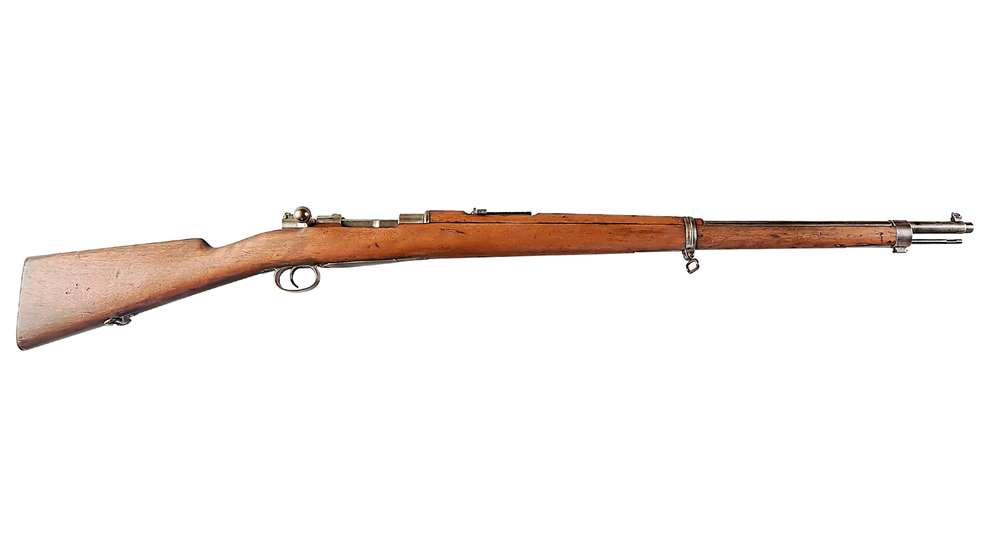
The Spanish were not a great power, and the popular memory of this war frames it as an easy American walkover. At the tactical level it was nothing of the kind. Spain had bought modern European hardware and trained on it.
Spanish regulars carried the Model 1893 Mauser, a bolt-action rifle in flat-shooting 7x57mm, fed by five-round stripper clips, firing smokeless powder. It outranged and outshot the single-loading Krag-Jørgensen carried by American regulars and badly outclassed the single-shot Springfield Trapdoors issued to volunteers. The smokeless powder meant Spanish infantry could pour fire into advancing American lines from concealed trenches without giving away a single position.
The Spanish artillery was worse news. They fielded the 7.5cm Krupp Modelo 1896 mountain gun, forged from German crucible steel, lighter and stronger than the American wrought-iron pieces, with a sliding-block breech that reloaded fast. It fired fixed smokeless ammunition, so it left no optical signature at all. And Spanish gunners had been trained in the Krupp school of indirect fire. Instead of parking their guns on a forward crest the way the Americans did, they sited their batteries in defilade, behind reverse slopes and under jungle canopy, and dropped plunging fire onto American troops who could not see where the shells were coming from and could not shoot back.
Put it together and the picture is brutal. American guns fired slowly, marked their own positions with smoke, and sat in the open. Spanish guns fired fast, stayed invisible, and used the American smoke as a target. At El Pozo the two Krupp guns on San Juan Heights bracketed Grimes inside three quarters of an hour and shut him down. American commanders ended up leaning on Lieutenant John Henry Parker's detachment of Colt-Browning machine guns, called Gatling guns in the period accounts, for the sustained suppressive fire the artillery could not deliver.
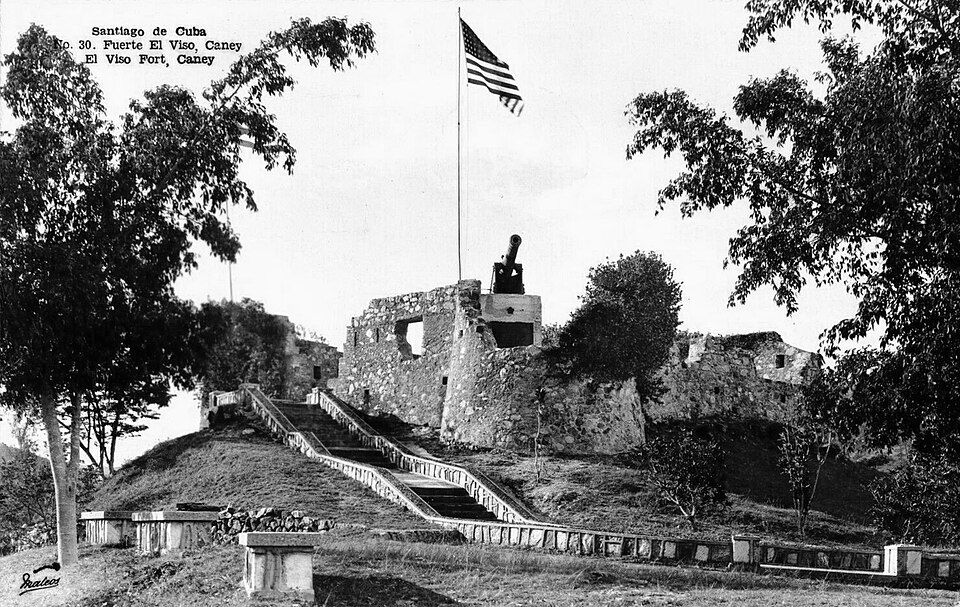
At El Caney that same day, Captain Allyn Capron's Battery E of the 1st Artillery opened on the stone fort of El Viso from about 2,300 yards. Capron fought that battle having passed the fresh grave of his own son, a Rough Rider killed a week earlier at Las Guásimas. From that range, with no high-explosive breaching shells, his 3.2-inch guns could not crack the stone walls. The fight that General Shafter expected to take two hours ground on all day. It broke only when Capron pushed his guns forward to within 1,000 yards and blew holes in the blockhouse at near point-blank range, after the infantry had already paid for the delay in blood. The old histories that say American artillery shattered the El Caney defenses and cleared the way have it backward. The guns were ineffective for most of the day. The infantry carried it.
The Reckoning
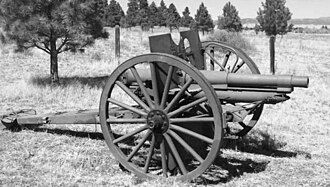
The realization that the United States had just been outgunned by a second-rate European power using export-model German equipment hit the War Department hard. Ordnance historians call it the U.S. Panic of 1899. It became the direct catalyst for a sweeping overhaul.
The full move to smokeless powder for field artillery came right after the war, alongside the gun that replaced the 3.2-inch entirely. The M1902 3-inch field gun brought steel construction, smokeless propellant, and an on-carriage recoil system, which meant the gun no longer had to be re-aimed after every shot. That one change made sustained, accurate fire possible and made it possible to hide the gun while firing it.
The institutional fixes ran just as deep. Secretary of War Elihu Root tore down the old bureau system. The Artillery Corps was split in 1901, and formally separated into Coast Artillery and Field Artillery branches in 1907, because the two jobs had nothing in common anymore. The Field Artillery Board was established, and the School of Fire at Fort Sill was founded, shaped heavily by Captain Dan T. Moore's study of the German artillery schools. Indirect fire, scientific gunnery, and optical range finding stopped being foreign curiosities and became permanent American doctrine.
What the Gunners Bought
Everything modern about putting steel on a target at distance, the idea that you range first and fire second, that you hide the gun and still hit what you cannot see, that the instrument matters as much as the gunner, traces back through the lessons that men paid for at El Pozo and El Caney. In 1898 an American gun crew judged distance with the naked eye and corrected by watching their own shells fall through a cloud of their own smoke. The shooter behind a precision optic today, dialing a known range onto a target before the first shot, is standing at the far end of a line that runs straight back to those guns on the hill.
The men were hard to kill even when their gear was a generation behind. The gap they fought through is exactly what forced the next century of getting it right.
Hard to Kill. Forever Free.
To learn more about the American Warrior series go to https://www.americanwarrior250.com/
Related Posts

When the United States declared war on Germany in April 1917, the U.S. Army had 127,000 men, no division structures, and no formal sniper doctrine. This is the story of two flawed scopes, a metallurgical nightmare, and an Arkansas duck hunter who outshot all of it with iron sights.

Every doctrine you take for granted, fire and maneuver, base of fire, the squad automatic weapon, came out of four years of trial and error in the mud between 1914 and 1918. The machine gun is the weapon that broke infantry combat and forced every army on earth to rebuild it from the ground up.

Every BDC reticle, every auto-gating Gen 3 night vision tube, every side focus knob exists because of decisions made under fire in a triple-canopy jungle half a century ago. Vietnam was not just a military conflict. For precision optics, it was the crucible.

A Colorado company, born on the 4th of July, 2018
Helpful Links

Join the Revolution
Join our e-mail newsletter for giveaways, hot deals, and Swampfox news.
©2026 Swampfox Optics. All rights reserved.
Designed and powered by WebriQ.